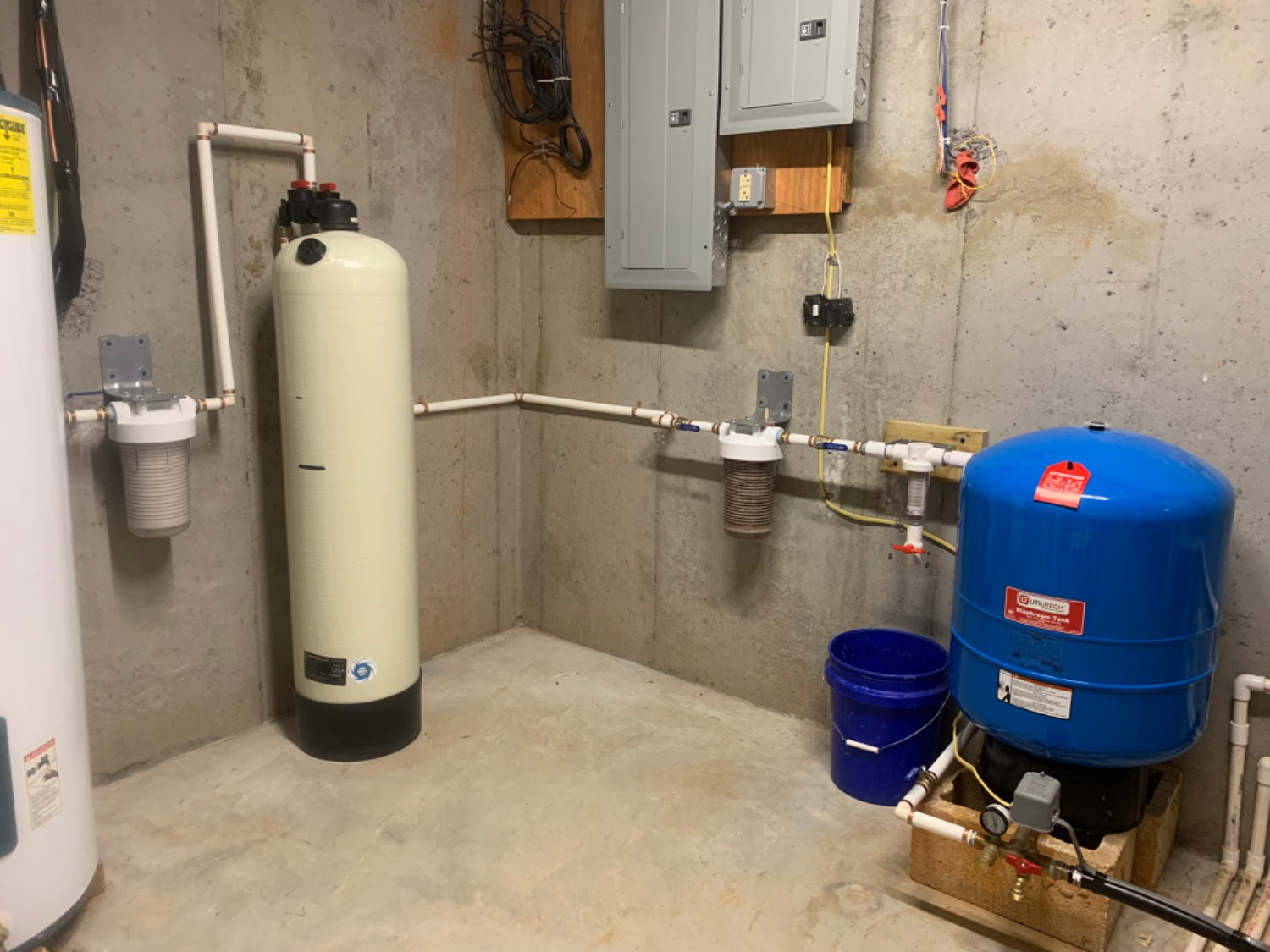
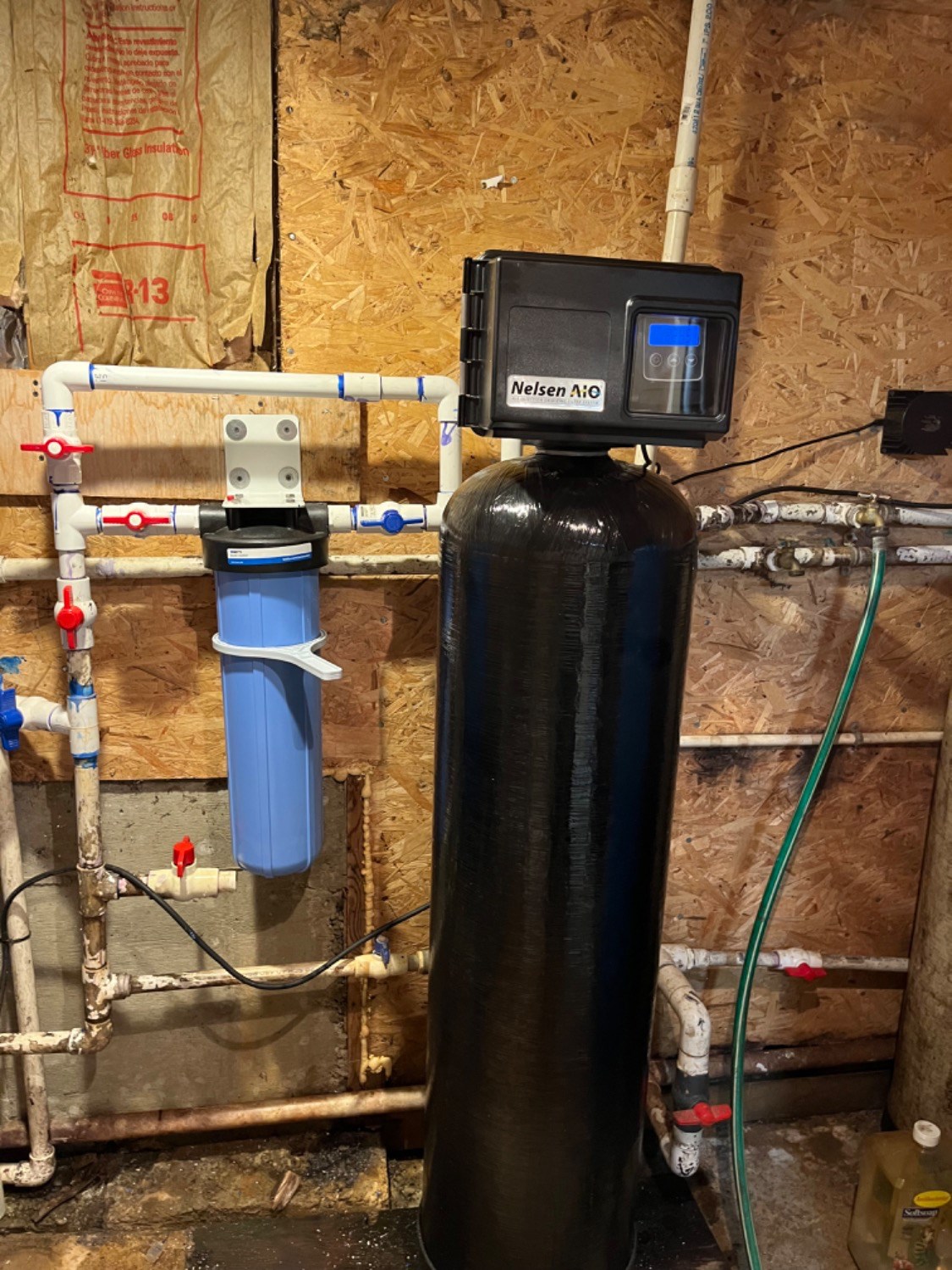
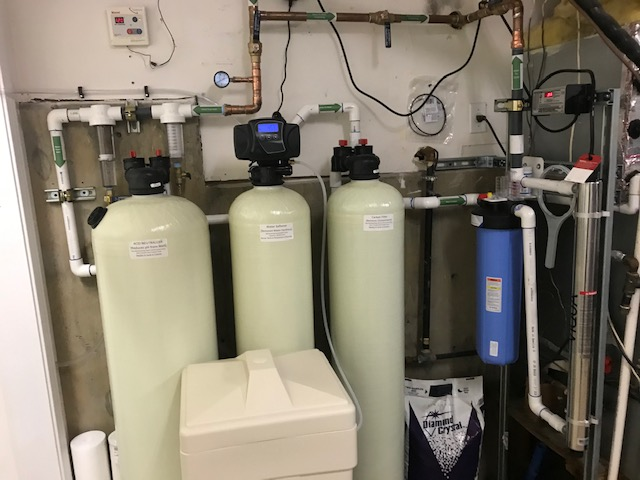
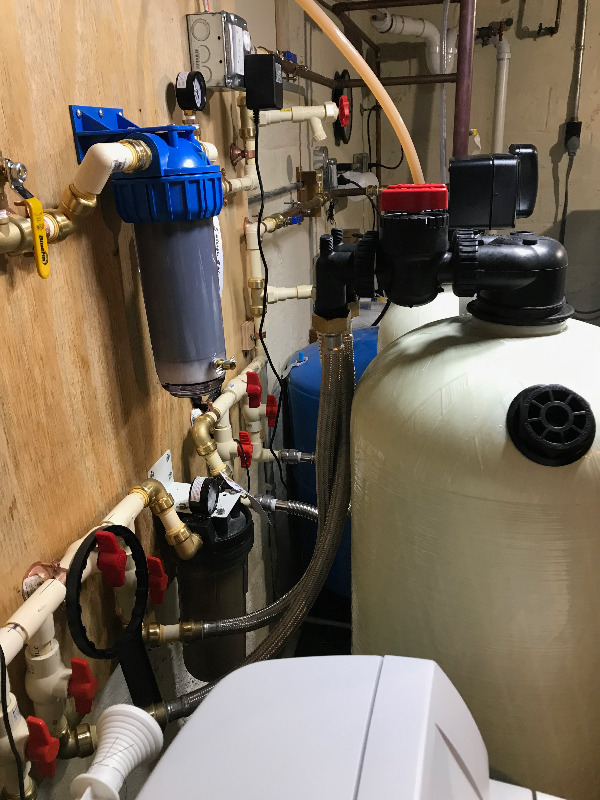
This page is a complete buying guide for whole house sediment filters, for city water and well water. It covers: what a whole house sediment water filter removes (rust, scale, sand, silt, grit) and what it does not (chlorine, hardness, dissolved iron, bacteria, PFAS, lead); how to tell whether your house needs a home sediment water filter (rusty water after water-main work, the free toilet tank test, grit in a glass, clogged aerators); whole house sediment filtration with Big Blue cartridge kits on Pentair Pentek housings and 5 micron polyspun cartridges (10 inch, $165, for 1 to 2 person homes; 20 inch, $195, the best whole house sediment filter for most homes, with roughly twice the dirt-holding capacity and 15 GPM service flow); reusable Rusco spin-down screen filters for coarse sand with zero cartridge cost (1 inch slip, $145, 1 to 25 GPM; 2 inch slip, $249, 18 to 100 GPM); the self-cleaning backwashing Turbidex tank on a Fleck 2510SXT valve, a whole house sediment filtration system for continuous heavy sediment ($1,895, 13x54 Vortech tank, 12 to 15 GPM service, requires drain and 110V); where a house sediment filter goes on city water (main line after the meter and pressure-reducing valve, before the water heater) and on a well (a whole house sediment filter for well water goes after the pressure tank, the Big Blue first ahead of any treatment tank and a spin-down last); why 5 micron is the standard rating; replacement cartridges and screens; a brand comparison against Express Water, iSpring, Culligan and US Water Systems; installation by a licensed plumber with phone support; and free expert sizing by phone. Household sediment filters ship free to all 50 US states. Mid Atlantic Water has specialized in water treatment since 1997.
Whole house sediment filtration for city and well water
By Aidan· 32 Year Water Expert, Mid Atlantic Water ·
A whole house sediment filter mounts on the main line where water enters the house and stops rust, scale, sand, silt and grit before they reach your fixtures, water heater and any treatment equipment behind it. It is mechanical: the water pushes through, the particles stay behind, and the same filter works on chlorinated city water and on a private well. The whole game is matching the filter to your particles. Rust flakes from the mains and fine silt from a well want a 5 micron Big Blue depth cartridge, the industry-standard rating. Visible coarse sand wants a Rusco spin-down screen you flush clean in seconds, with zero cartridge cost. Continuous heavy sediment wants the self-cleaning backwashing Turbidex tank.
Where it goes depends on your source. On city water: after the meter and pressure-reducing valve, before the water heater, softener or carbon filter. On a well: after the pressure tank, the Big Blue first ahead of any treatment tank, and a spin-down last (see our sediment filters for well water page for the full well layout). And it is mechanical only: chlorine, hardness, dissolved iron, bacteria, PFAS and lead pass straight through, so if your water has those problems too, Aidan will tell you exactly what handles them, free.
Works on city water and well water
Stops sand, silt, rust and scale to 5 micron
No electricity, no drain (cartridge and spin-down)
Pentair Pentek housings, NSF/ANSI 42
Free shipping, all 50 states
30-day return policy
Watch the 4-minute comparison guide
After 32 years of expert experience, with over 10,000 customers served since we started Mid Atlantic Water in 1997, the sediment advice we give most often costs us a sale: on city water, you probably do not need one unless you are actually seeing rust or grit. When you are, the same $165 to $195 Big Blue with a 5 micron cartridge does the job on municipal water and on a well; the water source only changes where it goes. Coarse sand wants a flushable Rusco screen. Only continuous heavy sediment justifies the backwashing tank. And none of them touch chlorine, hardness or dissolved iron, so we will tell you what does before you buy anything.
0 products match your filters.
No products match those filters. Try adjusting your water conditions or .
Big Blue Whole House Sediment Filter Kits (5 Micron)
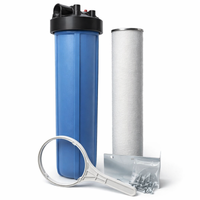
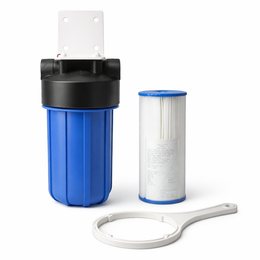
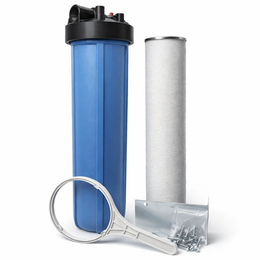
The whole-house default on city water and well water alike. A pressure-rated Pentair Pentek Big Blue housing with 1 inch NPT female ports, a mounting bracket, a housing wrench, and a 5 micron polyspun depth cartridge already seated inside. 15 GPM service flow at about 1 PSI of drop. No electricity, no drain. The 20 inch kit holds roughly twice the dirt of the 10 inch, so it goes about twice as long between cartridge changes. Fittings, valves and Teflon tape are not included.
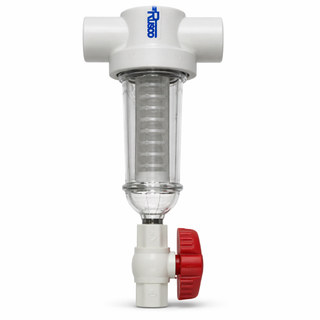
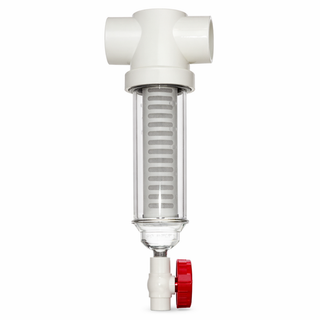
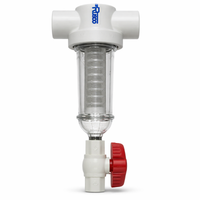
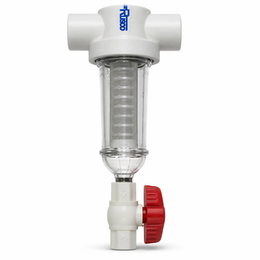
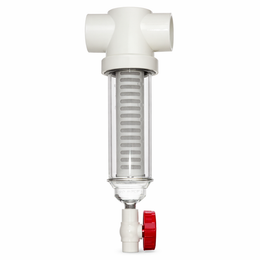
Flushable-screen filters for coarse sand and grit, and for catching stray media downstream of a treatment tank. Water spins inside the clear sump, heavy particles fling outward and settle above a ball valve, and a short blowdown at household pressure cleans the 60 mesh polyester screen with zero cartridge cost. Both are slip x slip PVC bodies (solvent-weld); slip x FPT bushings adapt them to threaded lines. The 1 inch handles 1 to 25 GPM; the 2 inch covers 18 to 100 GPM.
Backwashing Whole House Sediment Filter (Self-Cleaning Tank)
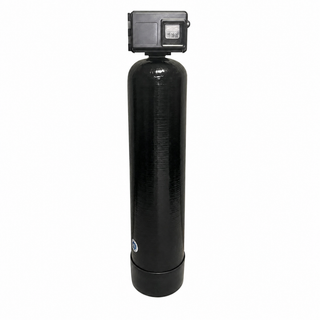
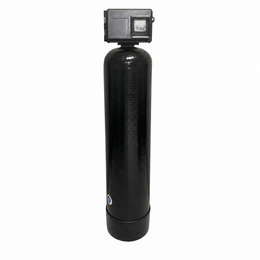
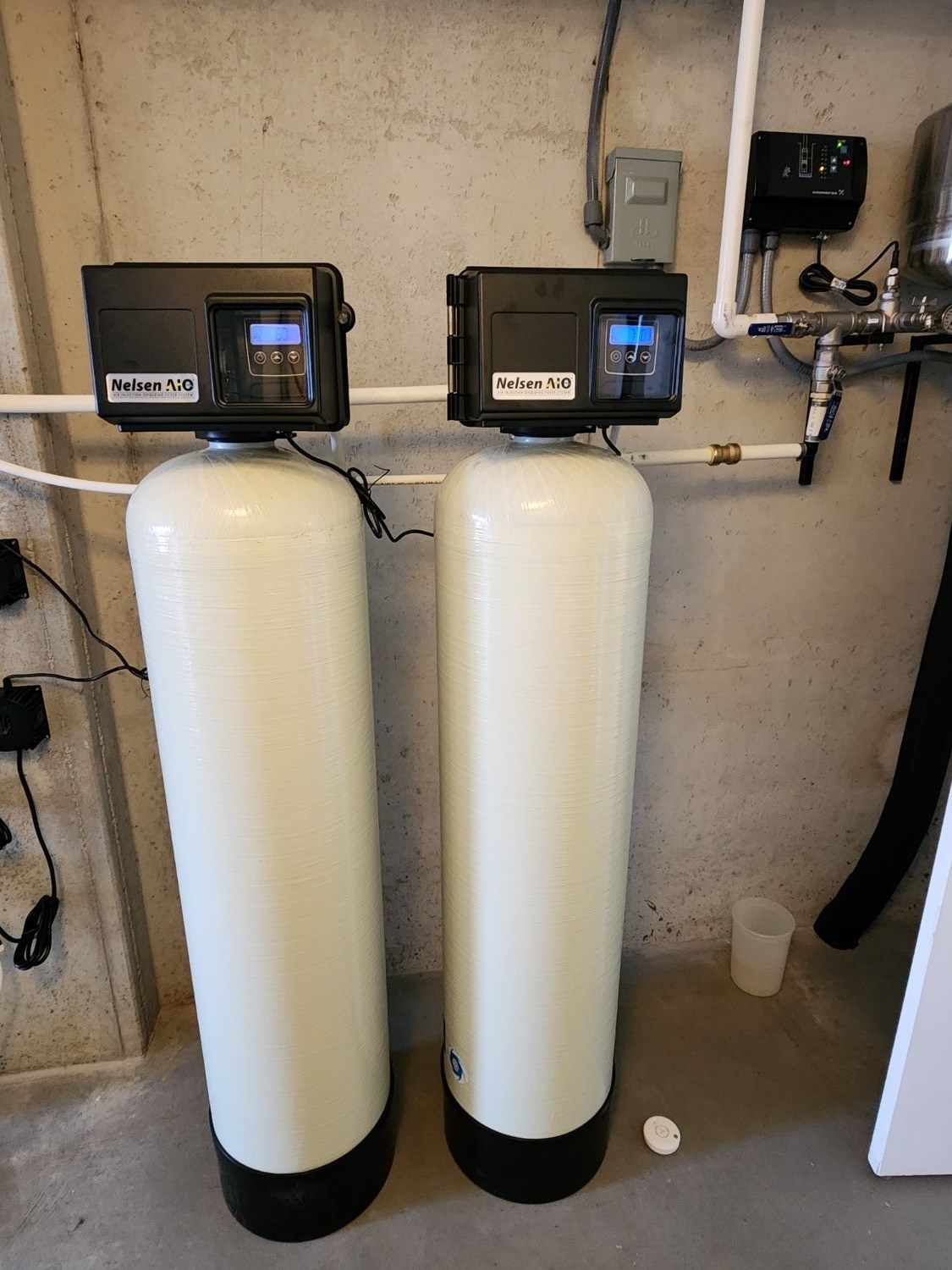
For continuous heavy sediment or turbidity where a cartridge would clog every few weeks. A 2.5 cubic foot 13 x 54 inch Vortech tank holds 2 cubic feet of Turbidex media with backwash freeboard above it; the Fleck 2510SXT valve reverses flow on a schedule and rinses the captured sediment to the drain. Nothing to replace on a schedule. Needs about 10 GPM of supply during backwash, a drain, and a 110 to 120V outlet. The tank ships empty; the Turbidex ships in separate bags and is loaded at install through the included fill funnel.
Keep the filter doing its job. The 20 inch 5 micron polyspun cartridge ($55) and the 10 inch Pentek WP5BB97P ($45) for the Big Blue housings, changed every 3 to 6 months under typical loads, and Rusco FS100 polyester replacement screens ($65) in 60 mesh and 140 mesh for the 1 inch spin-down.
Photo, PDF, or just type the numbers, whatever’s easiest. Don’t have a test yet? Describe what you’re seeing.
2
Aidan reads it personally
Real co-owner. Not a chatbot, not a script, not a sales rep on quota. He’s sized thousands of systems.
3
Get a direct link to what you need
Aidan texts you the exact product page that fits your water. Buy it, bookmark it, or take the answer elsewhere. No pressure either way.
We never send spam. We never sell your number. Aidan answers personally, 7 days a week, 8a–5p ET.
Whole House Sediment Filter Comparison
Mid Atlantic vs. Express Water, iSpring, Culligan & US Water Systems
Honest head-to-head: how our whole house sediment filters compare to the products most shoppers also look at for this search. Framing is taken from each company's own published product pages (US Water Systems checked September 2026; Express Water, iSpring and Culligan checked June 2026). Where a spec is not published we say so instead of guessing.
MAW Big Blue Kit
Express Water
iSpring WSP
Culligan
US Water Systems
Housing brand named and pressure-rated
Pentair Pentek Big Blue, NSF/ANSI 42 (150233 / 150237)
Yes: placement for both, and honest about what city sediment is
General
General
General
Well-focused
4.5" x 20" high-capacity cartridge option
Yes: about 2x the dirt-holding of a 10 inch
20 inch model offered
No cartridge (screen only)
10 inch format
4.5 x 20 offered
Cartridge, spin-down AND backwashing in one lineup
Yes: Big Blue, Rusco, and a self-cleaning Turbidex tank
Cartridge systems
Spin-down only
Cartridge housings
Cartridge, spin-down and backwashing
Rated service flow published
15 GPM at about 1 PSI drop with the 5 micron cartridge
High flow claimed; GPM not published
Up to 20 GPM claimed
Not specified
Up to 25 GPM (20 inch)
Micron honesty (5 vs 1 micron trade-off explained)
Yes: 5 micron standard; 1 micron clogs fast and we say so
Not addressed
Mesh sizes listed
Not addressed
Yes, on the collection page
Sized to your home and water source, free
Yes, phone or email with Aidan, 7 days a week
No
No
No
Phone, weekdays and Saturday
Price
$165 to $195 (complete Big Blue kits)
$142.99
From $41.99 (screen filter)
$73.55 (housing only)
From $186.95 (4.5 x 20)
The detail that matters most is matching the technology to your sediment, not the brand on the housing. Rust flakes and scale from city mains, and fine silt from a well, want a 5 micron depth cartridge. Coarse sand wants a flushable spin-down screen so you are not burning cartridges on grit. A supply that clogs a cartridge every few weeks wants the self-cleaning backwashing tank. A spin-down alone (the iSpring approach) misses fine silt entirely, and a single cartridge housing clogs fast on coarse sand. We sell all three technologies, so the recommendation you get is the right tool, not the only tool on the shelf.
One more honesty note: a sediment filter is mechanical. It will not remove chlorine, hardness, dissolved iron, bacteria, PFAS or lead, no matter whose name is on it. On city water the things you can taste and smell are chlorine and chloramine, which is a carbon filter's job. On a well, stains and smells are dissolved minerals, which need their own treatment tank. Send us your water test and we map the whole thing free.
Step 1: Find Your Problem
What are the signs of rust, scale, sand, silt and grit in household water?
Sediment is the one water problem you can see. Rusty water after the utility works on the mains, grit in a glass, a layer in the toilet tank, clogged aerators. The trap runs the other direction: stains, smells, scale and chlorine taste are dissolved, not particles, and no sediment filter will touch them. Check the signals below to confirm you are on the right page, and see what to do when the signal points somewhere else.
Rust-colored water after water-main work or hydrant flushing (city water)
When the utility flushes hydrants or repairs a main, rust and scale that has been sitting in old iron pipe breaks loose and rides into your house. It clears in an hour, then comes back the next time. That is sediment: solid particles a 5 micron cartridge catches on the main line before they reach your water heater, valves and fixtures. Sediment filters do not touch chlorine taste; that is a carbon filter's job.
→YESWhole house sediment filter fixes this
Sand or grit settles in a glass of water
Fill a clear glass and let it sit. Particles that sink to the bottom are sediment: sand, silt, grit, or rust flakes. On a well it is coming from the aquifer or a worn pump screen; on city water it is scale from the mains or your own pipes. Either way it is exactly what mechanical filtration catches. Fine particles that settle slowly want a 5 micron cartridge; visible coarse sand wants a spin-down screen.
→YESWhole house sediment filter fixes this
The toilet tank test: a layer of sediment in the cistern
Lift the toilet tank lid. The tank is a settling basin that refills on every flush, so a layer of sand, rust or tan sludge across the bottom means your supply is delivering sediment all day, even when the water in the glass looks clear. It works on city water and well water alike, it is the single most reliable home check, and it is free.
→YESThe free diagnostic check
Clogged faucet aerators, showerheads, and dripping fixtures
Unscrew a faucet aerator. Grit packed in the little mesh screen is sediment that already traveled through your water heater, every valve and every appliance to get there. The same particles wear out fixture cartridges, stick toilet fill valves, and grind away at washing machine and dishwasher inlet valves. A filter on the main line stops it where the water enters the house.
→YESStop it at the main line
Orange stains, rotten-egg smell, white scale, or chlorine taste
These are the calls we get most, and none of them is sediment. Orange stains are dissolved iron, rotten-egg smell is hydrogen sulfide, white crust is hardness, and the pool smell is chlorine. All of them pass straight through every cartridge and screen on this page because they are dissolved, not particles. Iron and sulfur need an iron filter, hardness needs a softener, chlorine needs carbon. A sediment filter can still protect that equipment, but it will not fix the symptom.
→NONot sediment: dissolved minerals or chlorine
Not sure whether it is particles or something dissolved?
Most sediment calls we take start with one question, city water or well, and then fit one of these patterns. Find your situation and you will see exactly which filter to start with and where it goes.
City water: rust and scale from the mains3+ people or any main-line protectionRust flakes and scale after main work or hydrant flushing; the 20 inch Big Blue holds about 2x the dirt of a 10 inch
Private well: silt, fine sand, rustFirst stage after the pressure tankOn a well the 5 micron Big Blue goes first after the pressure tank, ahead of any iron filter, neutralizer or softener
Visible coarse sand, or media escaping a tankFlushable 60 mesh screenThe Rusco spin-down traps coarse grit in a clear sump you flush in seconds; on a well it goes last, after the treatment tanks
Constant heavy sediment or turbiditySelf-cleaning, no cartridgesThe backwashing Turbidex tank rinses itself to the drain automatically; needs a drain and a 110V outlet
Well with treatment tanks: protect them AND catch what they let pastBig Blue first, Rusco lastThe 5 micron Big Blue goes ahead of the tanks; a Rusco spin-down after them catches any media a tank lets past
Just want the safe default? The 20" Big Blue kit at $195 is the whole-house standard on city water and wells: 5 micron, 15 GPM, about 2x the cartridge life of a 10 inch. One or two people in the house? The 10" kit is $165. Visible coarse sand? The $145 Rusco spin-down catches it on a screen you flush instead of a cartridge you buy. On a private well, read our sediment filters for well water page for placement after the pressure tank. Keep scrolling for sizing.
Size by sediment type and peak flow, not just house size. A 1 to 2 person home with light to moderate sediment fits the 10" Big Blue (15 GPM); more people, heavier sediment, or fewer cartridge changes wants the 20" Big Blue. Visible coarse sand belongs on a Rusco screen: the 1" covers 1 to 25 GPM, the 2" covers 18 to 100 GPM for irrigation and big homes. Continuous heavy sediment that would clog any cartridge in weeks gets the self-cleaning backwashing Turbidex tank (12 to 15 GPM service). City water and well water size the same way; only the placement differs.
10" Big Blue Kit (4.5" x 10" cartridge)
20" Big Blue Kit (4.5" x 20" cartridge)
Most Popular
Rusco Spin-Down NT100-60 (1")
Large Rusco Spin-Down NT200-60 (2")
Backwashing Turbidex Tank (Fleck 2510SXT)
Tank size
Housing 13.30"H x 7.45"W, 1" NPT female ports, 100 PSI
Housing about 21" tall, 1" NPT female ports, 90 PSI
11-3/8" x 5", 1" slip x slip PVC (bushings adapt to threaded line), 150 PSI
17-7/8" x 5-1/2", 2" slip x slip PVC, 150 PSI
13" x 54" Vortech tank, 62" total height, 1" stainless bypass
Household
1-2 people
3+ people
1-3 people
Any size
Any size
Bathrooms
1-2
Any, or heavy sediment
1-2
5+ / irrigation
Continuous heavy sediment
Capacity
Rust, scale, sand & silt to 5 micron
Rust, scale, sand & silt to 5 micron, about 2x dirt capacity
Coarse sand & grit on a reusable 60 mesh screen (about 250 micron)
Coarse sand & grit at high flow, 60 mesh screen
Heavy sediment & turbidity, self-cleaning
Service flow
15 GPM service flow
15 GPM service flow
1-25 GPM
18-100 GPM
12-15 GPM service flow
Max flow before pressure drop
15 GPM
15 GPM
25 GPM
100 GPM
15 GPM
Maintenance
Cartridge change every 2-6 months
Cartridge change every 3-6 months
Short flush at the ball valve, zero cartridge cost
A micron rating is the particle size a cartridge catches. 5 micron is the industry-standard whole-house rating: fine enough to grab rust flakes, scale, sand and silt, open enough to pass 15 GPM at about 1 PSI of drop. Going finer to 1 micron sounds better but clogs fast; as Aidan puts it on camera, a 1 micron cartridge 'might clog up pretty quick if there's a lot of sediment.' The Rusco screens work the other direction: the 60 mesh screen they ship with is about 250 micron, built for coarse grit, and 140, 500 and 1000 mesh replacement screens step finer if you need them.
Cartridge vs spin-down vs backwashing
Three technologies, three jobs. A Big Blue depth cartridge catches fine particulate down to 5 micron but is consumable: change it every 3 to 6 months (2 to 6 on the 10 inch). A Rusco spin-down catches coarse sand and grit on a reusable polyester screen you flush in seconds, with zero cartridge cost, but it passes fine silt and rust fines. The backwashing Turbidex tank cleans itself to a drain and handles continuous heavy sediment that would clog a cartridge every few weeks. Most city homes and most wells land on the Big Blue; the spin-down and the tank are for specific loads.
Where it goes: city water vs well water
On city water the filter mounts on the main line where water enters the house, after the meter and any pressure-reducing valve, before the water heater, softener or carbon filter. On a private well everything goes after the pressure tank, never between the pump and the tank: the 5 micron Big Blue goes first, ahead of any iron filter, acid neutralizer or softener, and a Rusco spin-down goes last, after the treatment tanks, to catch any media a tank lets past. Our sediment filters for well water page walks through the well layout in detail.
10" Big Blue Kit (4.5" x 10" cartridge)
$165
Household
1-2 people
Bathrooms
1-2
Capacity
Rust, scale, sand & silt to 5 micron
Tank size
Housing 13.30"H x 7.45"W, 1" NPT female ports, 100 PSI
Every filter on this page is mechanical: it physically traps particles while water pushes through, no chemicals, no resin, no salt. That is why the same filter works on chlorinated city water and on a private well. The three technologies differ in what they catch and how they clean. A depth cartridge captures fine particles in a thick polyspun wall and gets replaced. A spin-down throws coarse particles out of the flow with centrifugal motion and gets flushed. A backwashing media tank traps sediment in a granular bed and rinses itself to the drain automatically.
01
Depth cartridge: rust, scale and silt stop in the polyspun wall
In a Big Blue housing on the main line, water pushes through the thick wall of a 5 micron polyspun depth cartridge. Rust flakes and scale from city mains, or sand and silt from a well, wedge into the fiber matrix at every depth of the wall. That is why a 4.5" x 20" cartridge holds roughly twice the dirt of a 10 inch and goes months between changes. No electricity, no drain, no moving parts, and it works the same on chlorinated water and well water.
02
Spin-down: centrifugal motion flings coarse grit out of the flow
In a Rusco spin-down, water enters the clear sump and spins. Heavy particles like coarse sand, grit and stray filter media get flung outward and settle below the 60 mesh polyester screen, above a ball valve. Open the valve for a few seconds and household pressure flushes the collected sediment out: the screen is reusable for years, so there is no cartridge cost at all. Fine silt passes a 60 mesh screen, which is why the Big Blue handles the fine work.
03
Backwashing media: the tank cleans itself to the drain
In the backwashing unit, water filters down through 2 cubic feet of Turbidex media in a 13" x 54" Vortech tank. On a schedule, the Fleck 2510SXT valve reverses the flow: water rushes up through the bed, lifts the trapped sediment, and rinses it to the drain, then the bed settles and goes back to work. Nothing to replace on a schedule. It needs about 10 GPM of supply during backwash, a drain, and a 110 to 120V outlet.
Installation
We ship it. Your plumber installs it.
We recommend installation by a licensed plumber, and Aidan supports your plumber by phone at 800-460-5810 (8 AM to 5 PM Eastern, 7 days a week). A Big Blue or Rusco is typically in within 1 to 2 hours: two connections, a bracket, no electricity, no drain. The backwashing tank is a longer job with a drain run and media loading.
1-2 hrs
Typical time for a licensed plumber to install a Big Blue or Rusco: two pipe connections and a bracket. The backwashing tank adds a drain run, media loading, and a valve program.
None
No electricity, no drain for the cartridge and spin-down filters. Only the backwashing tank needs a 110 to 120V outlet and a drain.
100%
Phone support for your plumber. Aidan is at 800-460-5810, 8 AM to 5 PM Eastern, 7 days a week, for anything unusual about your setup.
What to have ready
The right spot on the main lineCity water: after the meter and any pressure-reducing valve, before the water heater, softener or carbon filter, so every fixture is protected. Private well: after the pressure tank, never between the pump and the tank; the Big Blue goes ahead of any treatment tank.
Fittings and shut-off valves (not included)Big Blue housings have 1 inch NPT female ports. Both Ruscos are slip x slip PVC bodies (solvent-weld) that ship bare; slip x FPT bushings adapt them to threaded lines. Your plumber supplies the adapters, two isolation valves, and Teflon tape.
Clearance below the housingA Big Blue cartridge drops out of the bottom of the housing, so leave room under it to swing the sump off with the included wrench. The 20 inch housing stands about 21 inches tall; the 10 inch is 13.30 inches.
A bucket or drain for spin-down flushingRusco filters clean with a short blowdown through the bottom ball valve at household pressure. A bucket works; on 2 inch installs plumb the flush line to a drain.
Drain, outlet, and flexible tubing (backwashing tank only)The Fleck 2510SXT unit needs a floor drain or standpipe, a 110 to 120V outlet, about 10 GPM of supply during backwash, and 1/2 inch flexible drain tubing from the hardware store; drain tubing is not included. The tank ships empty and the Turbidex is loaded at install through the included fill funnel.
What your plumber will do
Close the main shut-off (city water) or shut off the well pump and close the valve after the pressure tank (well), then open a downstream faucet to relieve pressure.
Pick the mounting point: on city water, right after the meter and pressure-reducing valve; on a well, right after the pressure tank and ahead of any iron filter, acid neutralizer, softener, carbon tank or UV unit.
Mount the bracket (Big Blue kits include the bracket and wrench) and secure the housing so the pipe does not carry its weight.
Plumb the inlet and outlet matching the flow arrow on the housing cap. Big Blue ports are 1 inch NPT female; a Rusco is slip PVC, so solvent-weld it in or use slip x FPT bushings to meet threaded line.
Install isolation valves on both sides, and a pressure gauge port downstream if you want to watch for cartridge loading.
Hand-tighten the sump, then snug it with the wrench. Overtightening a Big Blue housing crushes the O-ring and causes the slow drip people blame on the filter. Lubricate the O-ring with silicone grease at every cartridge change.
For a Rusco: point the flush valve down and run a short flush line to a bucket or drain. For the backwashing tank: load the Turbidex through the fill funnel, connect the drain tubing and bypass, plug in the valve, and set the backwash schedule.
Open the supply slowly, check every joint for leaks, then run a downstream faucet until the water clears.
Note the date. Plan the first Big Blue cartridge check at 3 months (3 to 6 month interval; 2 to 6 on the 10 inch); flush a Rusco whenever the sump shows grit.
Show your plumber exactly what is going in. The system builder generates a plumbing schematic for your specific setup. Send it to your plumber before install day.
Cartridge vs spin-down vs backwashing for a whole house sediment filter
All three of our sediment technologies work on city water and well water; they just solve different particle problems. A depth cartridge polishes fines but is consumable. A spin-down screen never needs cartridges but passes fine silt. A backwashing tank cleans itself but costs ten times a cartridge kit and needs a drain and an outlet.
The honest mapping: rust, scale and fine silt go to the Big Blue, coarse sand goes to the Rusco, continuous heavy loads go to the backwashing tank, and a well with treatment tanks runs a Big Blue ahead of the tanks and a Rusco after them. Nothing on this page touches chlorine, hardness, dissolved minerals or bacteria; that is the job of the equipment behind it.
Feature
Big Blue 5 Micron Cartridge
Rusco Spin-Down Screen
Backwashing Turbidex Tank
Best at
Rust, scale, fine sand & silt (to 5 micron)
Coarse sand & grit (60 mesh, about 250 micron)
Continuous heavy sediment & turbidity
City water fit
The default when rust or grit is showing
Rarely needed
Almost never needed
Well water fit
First stage after the pressure tank
Last, after the treatment tanks
Turbid or very sandy wells
Cleaning
Replace cartridge every 3-6 months (2-6 on 10")
Short flush at the ball valve
Automatic backwash to drain
Ongoing cost
$45-$55 per cartridge
Zero (screen reusable for years; $65 spare)
Zero media cost (Turbidex is not consumed)
Electricity / drain
None
None (bucket or drain for flush)
110-120V outlet + drain required
Connections
1" NPT female
1" or 2" slip x slip PVC (bushings to thread)
1" stainless bypass
Service flow
15 GPM at about 1 PSI
1-25 GPM (1") / 18-100 GPM (2")
12-15 GPM continuous
Misses
Clogs fast on heavy coarse sand
Fine silt & rust fines pass through
Overkill for light loads
Removes chlorine, iron, hardness, bacteria?
No
No
No
Price
$165 - $195 complete kit
$145 - $249
$1,895
Real customers, real houses
What owners say about these whole house sediment filters
Every review is independently collected and verified by Stamped.io, a third-party review platform. We cannot edit or remove reviews.
★★★★★
Big Blue to the rescue.
Installed fairly easy. Looking forward to it taking the sediment issues away from my home well system. I should have installed this item years ago.
GR
Gregory R., United States
Verified Buyer
20" Big Blue Sediment Filter Kit · February 2025
★★★★★
Excellent filter!
This is a great sediment filter. There is no filtration media to replace -- simply open the ball valve to flush out the collected sediment. But be careful, because there is a surprising amount of pressure when you open the valve. It is probably best to run a hose from the valve down to your sump.
SS
Stephen S., United States
Verified Buyer
Rusco Spin-Down Filter, 1 Inch (Standard) · March 2020
★★★★★
Big blue sediment filter
Worked out great, easy install
VB
Verified Buyer, United States
Verified Buyer
20" Big Blue Sediment Filter Kit · July 2024
FAQ
Frequently asked questions
For most homes, a 20 inch Big Blue housing with a 5 micron cartridge, on city water or a well. It holds roughly twice the dirt of a 10 inch, flows 15 GPM at about 1 PSI of drop, and 5 micron is the industry-standard rating that catches rust, scale, sand and silt without choking flow. The exceptions: visible coarse sand wants a Rusco spin-down screen (reusable, zero cartridge cost), and continuous heavy sediment that clogs cartridges in weeks wants the self-cleaning backwashing Turbidex tank. One to two person homes can step down to the 10 inch kit.
$145 to $249 for a complete cartridge or spin-down filter; $1,895 for a self-cleaning backwashing tank. Our 10 inch Big Blue kit is $165 and the 20 inch is $195, each with the housing, bracket, wrench and a 5 micron cartridge. The 1 inch Rusco spin-down is $145 and the 2 inch is $249. Ongoing cost is a $45 (10 inch) or $55 (20 inch) cartridge every 3 to 6 months for a Big Blue, and nothing for a Rusco beyond an occasional $65 screen. Add your plumber's time: a Big Blue or Rusco is typically in within 1 to 2 hours.
Every 3 to 6 months for a 20 inch Big Blue cartridge, 2 to 6 months for a 10 inch, and sooner if pressure drops at the taps. City water with occasional rust from main work sits at the long end of that range; a well with steady silt sits at the short end. A Rusco spin-down screen is not replaced on a schedule: you flush it whenever the clear sump shows grit, and the polyester screen lasts years. The backwashing tank has no cartridge at all; Turbidex is rinsed, not consumed.
5 micron for the main-line cartridge. It is the industry-standard whole-house rating: fine enough for rust flakes, scale, sand and silt, open enough to pass 15 GPM. Going to 1 micron sounds better but the cartridge loads up fast and you will be changing it constantly. Coarse screens run the other way: the Rusco ships with a 60 mesh screen (about 250 micron) built for grit, with 140, 500 and 1000 mesh replacement screens if you want finer. Filter at 5 micron and go finer only if a specific particle problem persists.
Only if you are seeing sediment. Most city homes are not, and we say so on the phone. Municipal water is filtered at the plant, so the sediment that reaches a city house is rust and scale shaken loose from old mains during repairs and hydrant flushing, or from your own galvanized pipe. If you get rusty water after utility work, grit in the aerators, or a layer in the toilet tank, a 5 micron Big Blue on the main line stops it. If your complaint is taste or smell, that is chlorine, and you want a carbon filter instead; a sediment filter does not remove chlorine, hardness, lead or PFAS.
Three honest ones: it only removes particles, a cartridge is a recurring cost, and an undersized or too-fine filter costs you pressure. A sediment filter will not touch chlorine, hardness, dissolved iron, bacteria, PFAS or lead, so it is not a substitute for a carbon filter, softener or iron filter. A Big Blue cartridge runs $45 to $55 every 3 to 6 months (a Rusco screen avoids that). And a 1 micron cartridge or a 10 inch housing on a big, dirty supply loads up fast and drops pressure. Sized right, a clean 20 inch Big Blue costs about 1 PSI at 15 GPM.
On the main line where water enters the house, after the meter and any pressure-reducing valve, and before the water heater, softener or carbon filter. That order protects everything behind it: the heater's dip tube and valves, softener resin, carbon media, and every fixture cartridge in the house.
City sediment is rust and scale shaken loose from old iron mains during repairs and hydrant flushing, or from your own galvanized pipe, not sand from an aquifer, so the load is usually light and intermittent. A 5 micron Big Blue on the main line catches it. Your plumber installs isolation valves on both sides so cartridge changes take a few minutes.
After the pressure tank. Never between the pump and the tank, where a loading filter would fight the pump and the pressure switch. After the tank, the 5 micron Big Blue goes first, ahead of any iron filter, acid neutralizer, softener, carbon tank or UV unit, because sand and silt are what wear out those systems.
If you also run a Rusco spin-down, it goes last, after the treatment tanks, where it catches any media a tank lets past. Our sediment filters for well water page walks through the full well layout, including pump screens and wells that turn cloudy after rain.
No. A sediment filter is mechanical: it catches particles you could see settle in a glass. Chlorine and chloramine taste on city water, dissolved (clear-water) iron that stains orange, hardness that leaves white scale, bacteria, PFAS and lead are all dissolved or far smaller than 5 micron, and every one of them passes straight through a cartridge, a screen, and a Turbidex bed.
Chlorine wants a carbon filter, iron wants an iron filter, hardness wants a softener, bacteria want UV. The sediment filter's job in those systems is to protect them, so it goes ahead of them. Send us a water test and we map the order free.
Big Blue kit: the Pentair Pentek housing (1 inch NPT female ports), the mounting bracket, the housing wrench, and a 5 micron polyspun cartridge already seated in the housing. Fittings, isolation valves and Teflon tape are not included. Rusco spin-down: the housing with its 60 mesh polyester screen and flush ball valve, shipped bare. Both Ruscos are slip x slip PVC bodies for solvent-weld connection; your plumber adds slip x FPT bushings to meet a threaded line. No bushings or fittings are included.
Backwashing tank: the 13 x 54 Vortech tank (empty), the Fleck 2510SXT valve with a stainless 1 inch bypass, the Turbidex media in separate bags, and a fill funnel for loading the media at install. Drain tubing is not included; the plumber runs 1/2 inch flexible tubing to a floor drain or standpipe.
On a well with treatment tanks, the Big Blue goes first and the Rusco goes last. The 5 micron cartridge is the first stage after the pressure tank so sand and silt never reach an iron filter, acid neutralizer or softener; the Rusco sits after those tanks, where its 60 mesh screen catches any media a tank lets past and flushes it out in seconds.
On a supply with heavy coarse sand and no treatment tanks, a Rusco on its own does the bulk removal and a Big Blue behind it polishes the fine silt the screen passes. Either way the screen never needs a cartridge, and the cartridge lasts longer for it.
A correctly sized one barely registers: the Big Blue housings pass 15 GPM at about 1 PSI of drop with a clean 5 micron cartridge, and the Rusco spin-downs flow 1 to 25 GPM (1 inch) and 18 to 100 GPM (2 inch) with minimal restriction.
Pressure loss shows up in two situations: a cartridge that is loaded with sediment and overdue for a change, or a filter that is undersized or too fine for the load (the classic 1 micron mistake). If pressure sags weeks after each new cartridge, that is the signal to step up to the 20 inch housing, add a Rusco for the coarse grit, or move to the backwashing tank, not to live with it.
When sediment is continuous and heavy enough that a cartridge clogs every few weeks, the math flips. The backwashing unit is a 2.5 cubic foot 13 x 54 inch Vortech tank holding 2 cubic feet of Turbidex media (the rest is backwash freeboard) and the Fleck 2510SXT valve rinses the trapped sediment to the drain automatically. There is no cartridge to buy; Turbidex is a long-life media that is backwashed, not consumed.
The trade-offs are real, which is why we do not lead with it: it costs $1,895, needs a floor drain, a 110 to 120V outlet and about 10 GPM of supply during backwash, and it is a longer plumber job because the tank ships empty and the media is loaded at install. It serves 12 to 15 GPM continuously and carries a 5 year valve and 10 year tank warranty. It is the right call for turbid wells and homes that are done changing cartridges; it is almost never the right call on city water.
Tell Aidan whether you are on city water or a well and what you are seeing. He replies with the right filter (10 or 20 inch Big Blue, a Rusco spin-down, or the backwashing tank), the right micron rating, and exactly where it goes on your line. Same-day during business hours, next morning otherwise.
✓
Your message is queued for Aidan
Your email client just opened with the message ready to send. Hit send and Aidan will reply same day during business hours.
Aidan
Co-owner. Real person. Not a bot. 7 Days/Week, 8AM-5PM EST