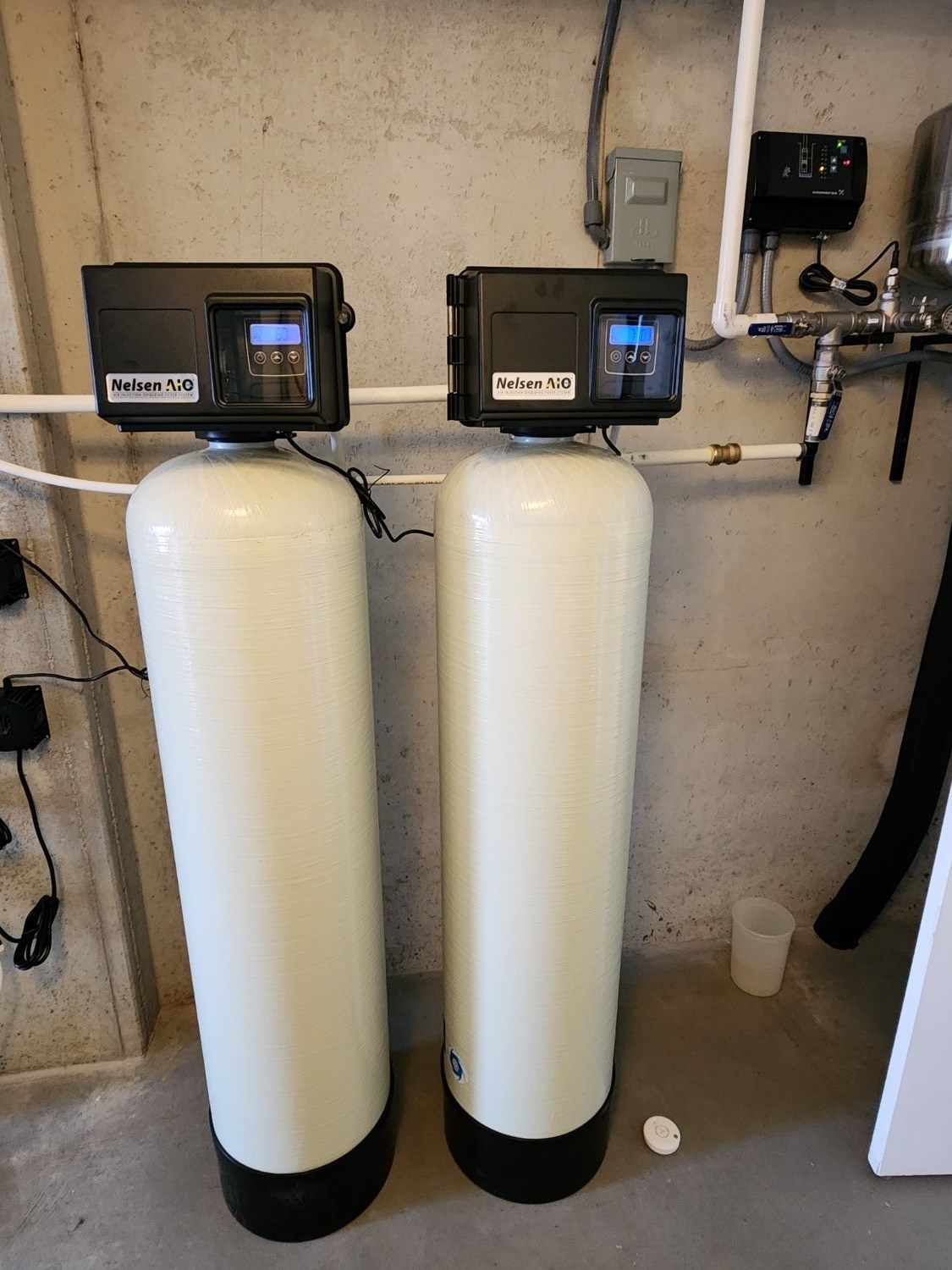
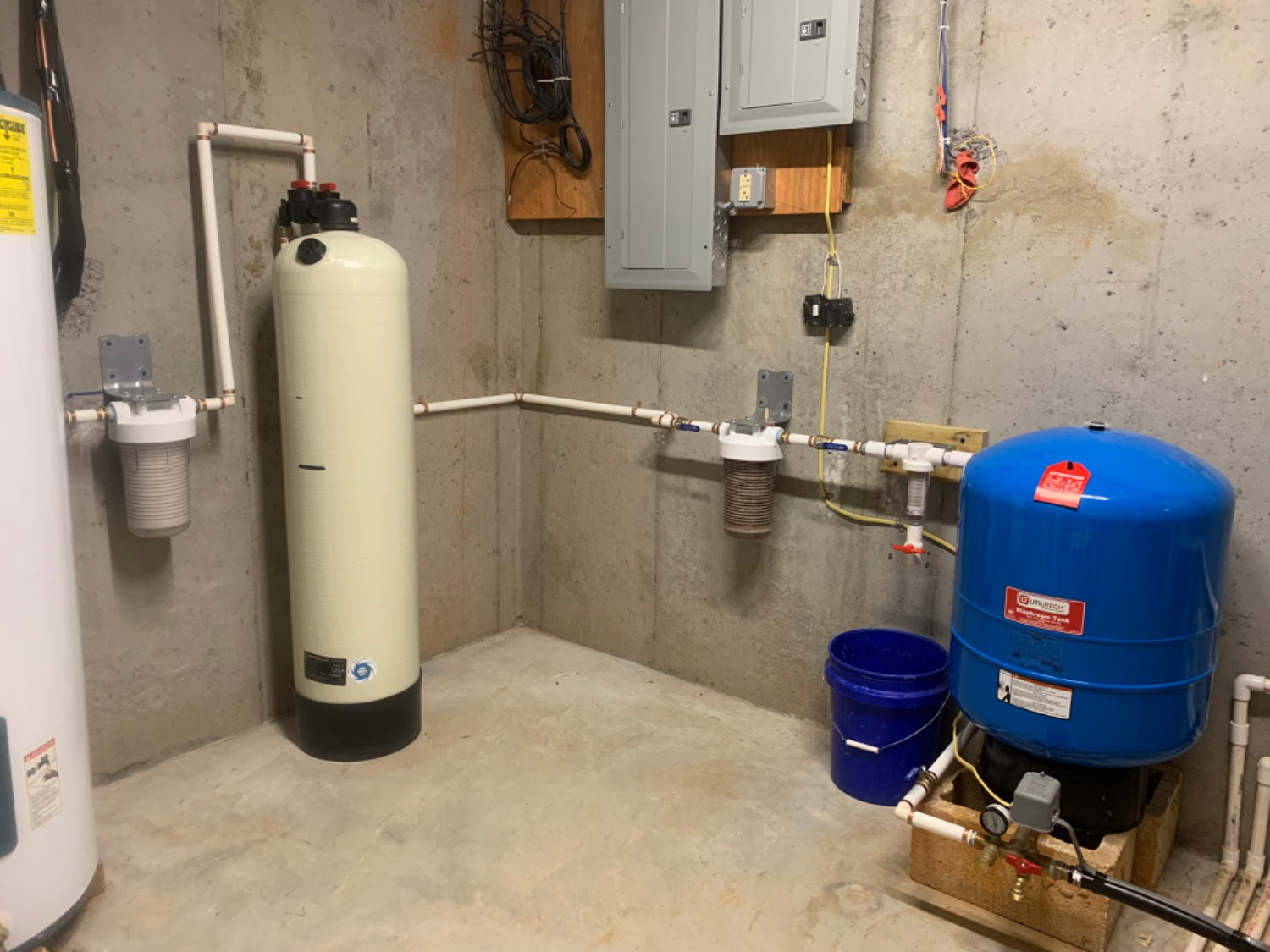
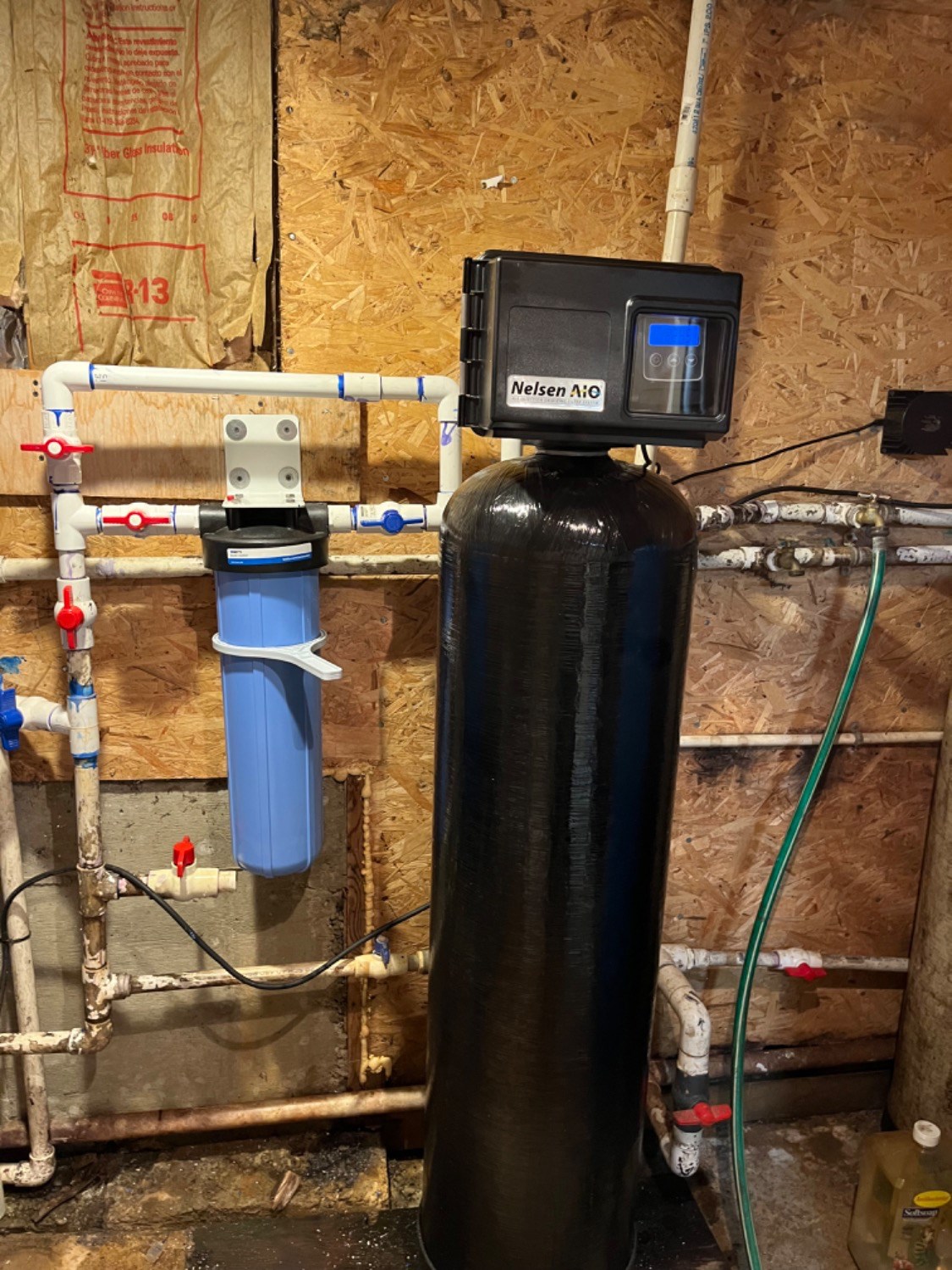
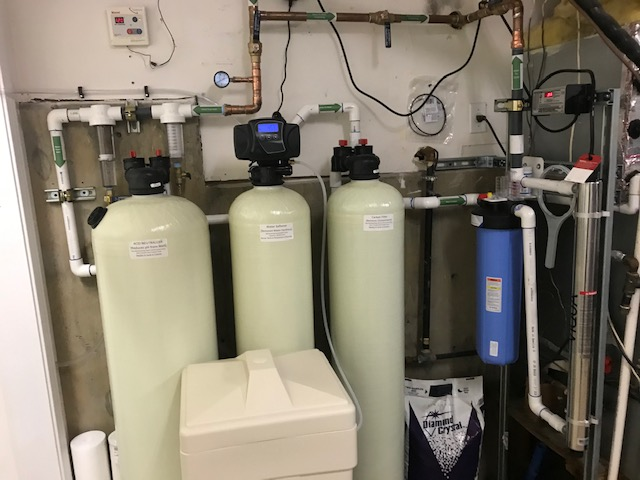
This page is a complete buying guide for spin-down sediment filters, specifically the Rusco spin-down water filter we sell in 1 inch and 2 inch. It covers: what a spin down filter is and how a spin down sediment filter works (water spins inside a clear sump, sand and grit drop below a reusable 60 mesh polyester screen of about 250 micron, and a 5 to 10 second flush at household pressure blows the sump clean, no cartridges); the Standard 1 inch Rusco spin down sediment filter (NT100-60, $145, 1 to 25 GPM, 150 PSI, 11-3/8 by 5 inches, 1 inch slip x slip PVC body, adapted to 3/4 or 1 inch threaded lines with slip x FPT bushings) and the Large 2 inch Rusco spin down water filter (NT200-60, $249, 18 to 100 GPM, 150 PSI, 17-7/8 by 5-1/2 inches, 2 inch slip ports usually reduced to 1.5 or 1.25 inch); Rusco replacement screens in 60, 140, 500 and 1000 mesh ($65 to $125); where a spin down sediment water filter goes on a well (after the pressure tank, last in line after the softener, acid neutralizer or iron filter, to catch coarse grit and any media a tank lets past; never between the pump and the pressure tank; the 5 micron Big Blue cartridge goes first); a spin down sediment filter for well water as a resin trap after a softener, a final polish ahead of a UV lamp, and a spin down filter for well water irrigation and sprinkler lines; what a spin-down does not do (fine silt, clay, cloudy water, dissolved iron, hardness, chlorine, bacteria); Rusco filters compared with iSpring, Waterdrop and generic Amazon spin-downs, and with the same Rusco sediment filter from other dealers; Rusco's Sediment Trapper filter line versus the Spin-Down; installation by a licensed plumber with phone support; and free sizing by phone. For the full well-water treatment line see our sediment filters for well water page; for city and well main-line filtration see whole house sediment filters. Every Rusco water filter here ships free to all 50 US states. Mid Atlantic Water has specialized in water treatment since 1997.
Rusco spin-down sediment filters: reusable screen, no cartridges
By Aidan· 32-year water expert, Mid Atlantic Water ·
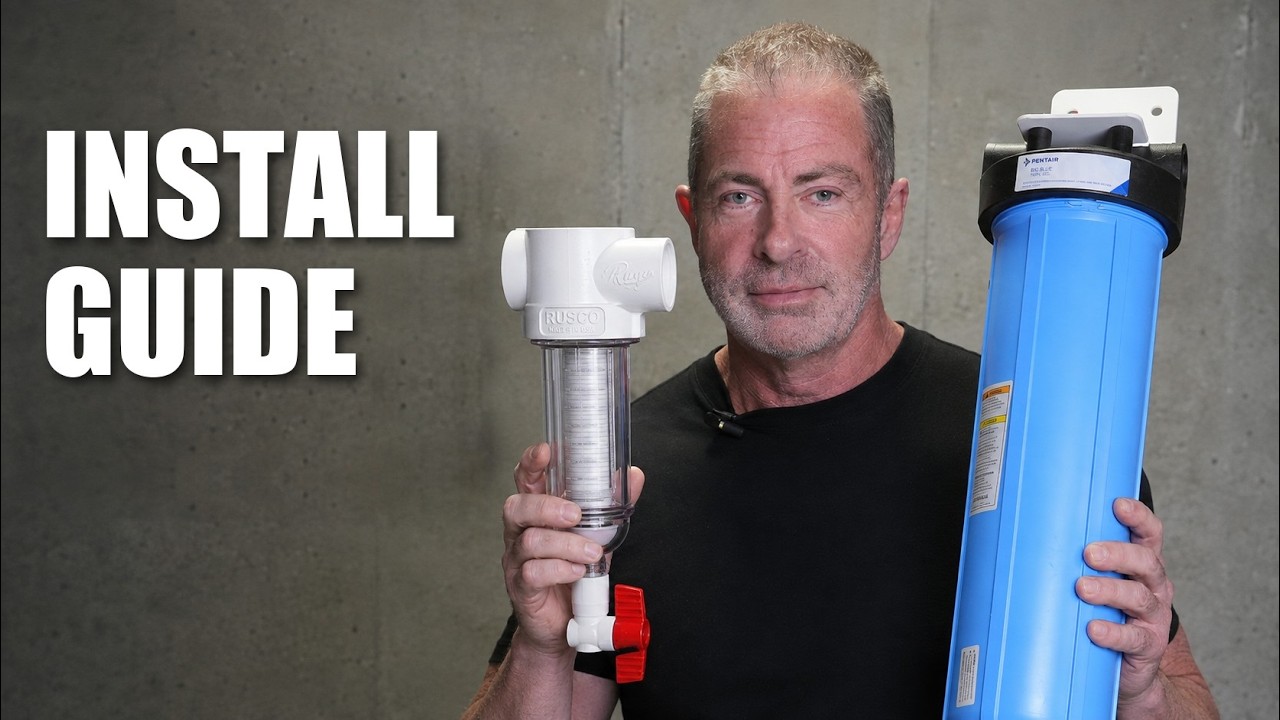
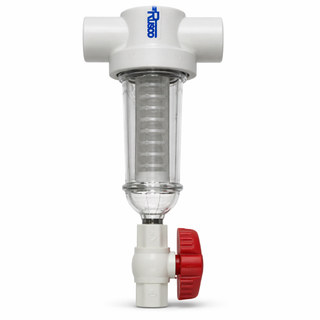
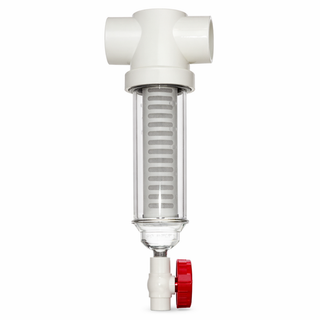
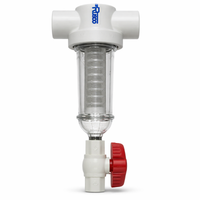
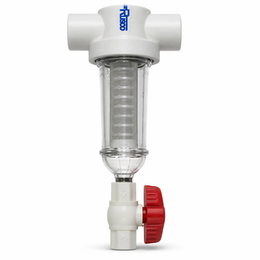
A spin-down sediment filter is the white inline filter with the clear sump and the red valve on the bottom. Water spins inside the sump, sand and grit drop below a reusable 60 mesh polyester screen (about 250 micron), and when the sump fills you put a bucket under it, open the valve, and 5 to 10 seconds of household pressure flushes it clean. No cartridges, no media, nothing to buy. We sell the basic Rusco with the polyester mesh in two sizes: the Standard 1 inch ($145, 1 to 25 GPM) for nearly every home, and the Large 2 inch ($249, 18 to 100 GPM) for 1.5 and 2 inch mains, pumps over 25 GPM and irrigation.
Where it goes surprises people: last in line. On a well, everything goes after the pressure tank; the 5 micron Big Blue goes first to protect the treatment tanks, and the spin-down goes after the softener, neutralizer or iron filter to catch coarse grit and any media those tanks let past. It is a coarse-sediment tool: fine silt, cloudy water, dissolved iron, hardness and bacteria pass straight through, and if that is your problem Aidan will say so before you buy. Our sediment filters for well water page covers the full line.
After 32 years of expert experience, with over 10,000 customers served since we started Mid Atlantic Water in 1997, the spin-down advice we give most often is the opposite of what the listings say: it goes last in line, not first, and it is not your fine-sediment filter. On a well the 5 micron Big Blue goes first after the pressure tank to protect the treatment tanks, and the $145 Rusco goes after those tanks to catch the resin, calcite or media they let past. It is the least expensive filter we sell, it costs nothing to run, and if your problem is cloudy water or iron stains we will tell you it is not the fix before you buy it.
0 products match your filters.
No products match those filters. Try adjusting your water conditions or .
Rusco Spin-Down Sediment Filters (1 Inch and 2 Inch)
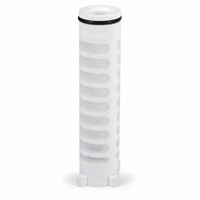
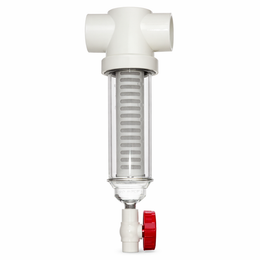
The complete filter: white PVC T-head, clear sump, 60 mesh polyester screen (about 250 micron) and a 1/2 inch flush ball valve with the red handle. Water spins inside the sump, sand and grit drop to the bottom, and a 5 to 10 second flush at household pressure cleans it out. No cartridges, no electricity, no drain required (a bucket works). Both are slip x slip PVC bodies for solvent-weld connection and ship bare; slip x FPT bushings adapt them to threaded lines. The Standard 1 inch is rated 1 to 25 GPM; the Large 2 inch is rated 18 to 100 GPM and needs 18 GPM of flow before the water spins.
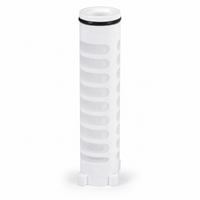
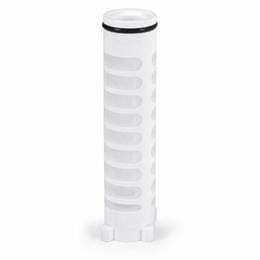
The 60 mesh screen that ships in the Standard Rusco lasts years; these are for a worn screen or for stepping the mesh finer. FS100-60 is the stock 60 mesh ($65). FS100-140 is 140 mesh ($65). NT100-500 is 500 mesh, about 30 micron ($65). FS100-1000 is 1000 mesh, about 15 micron ($85). Finer mesh catches finer sediment but loads up sooner, so you flush more often. None of them reaches 5 micron; that is cartridge work.
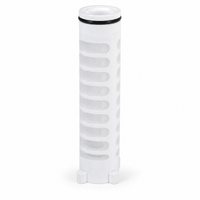
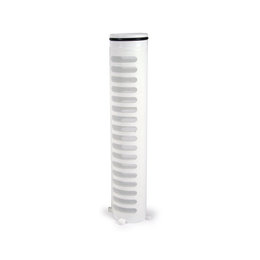
Finer screens for the Large Rusco: FS200-500 is 500 mesh, about 30 micron, and FS200-1000 is 1000 mesh, about 15 micron ($125 each). Both drop into the same 2 inch housing in place of the 60 mesh screen it ships with. Step finer only if the sump shows fine sand getting past the 60 mesh; a finer screen on a high-flow irrigation line will need flushing more often.
Photo, PDF, or just type the numbers, whatever’s easiest. Don’t have a test yet? Describe what you’re seeing.
2
Aidan reads it personally
Real co-owner. Not a chatbot, not a script, not a sales rep on quota. He’s sized thousands of systems.
3
Get a direct link to what you need
Aidan texts you the exact product page that fits your water. Buy it, bookmark it, or take the answer elsewhere. No pressure either way.
We never send spam. We never sell your number. Aidan answers personally, 7 days a week, 8a–5p ET.
Spin-Down Filter Comparison
Rusco from Mid Atlantic vs. iSpring, Waterdrop, Amazon & other Rusco dealers
Honest head-to-head against what comes up next to us when you search for a spin-down sediment filter. Framing is taken from each company's own published product pages (iSpring checked June 2026; Waterdrop and the Amazon category checked September 2026). Where a spec is not published, or changes from listing to listing, we say so instead of guessing. The last column is the same Rusco unit from a different store, because it is: the housing does not change with the dealer.
MAW Rusco Spin-Down
iSpring WSP-50
Waterdrop
Amazon generic
Rusco elsewhere
Housing maker named
Rusco / Vu-Flow (NT100-60, NT200-60), made in the USA, NSF/ANSI listed components
iSpring own brand
Waterdrop own brand
Varies by listing
Same Rusco housing
Screen that ships
60 mesh polyester, about 250 micron, reusable for years
50 micron stainless mesh
Not specified
Varies by listing
Same 60 mesh polyester
Rated flow published
1 to 25 GPM (1 inch); 18 to 100 GPM (2 inch)
Up to 20 GPM claimed
Not specified
Varies by listing
Same ratings
Max pressure published
150 PSI (Rusco)
Not specified
Not specified
Varies by listing
150 PSI
Connections explained honestly
1 inch slip x slip PVC (solvent-weld); slip x FPT bushings adapt to threaded lines; 2 inch slip on the Large
1 inch MNPT / 3/4 inch FNPT
Not specified
Varies by listing
Same slip x slip body; explanation varies by dealer
2 inch, 100 GPM model in the lineup
Yes: the Large Rusco NT200-60 for irrigation, 1.5 to 2 inch mains and big homes
1 inch only on the WSP
Not specified
Varies by listing
Yes
Replacement screens stocked
60, 140, 500 and 1000 mesh for the 1 inch; 500 and 1000 mesh for the 2 inch
Stainless replacements
Not specified
Varies by listing
Varies by dealer
Says plainly what a spin-down misses (fine silt, dissolved iron)
Yes, on this page and on the phone
Not addressed
Not addressed
Not addressed
Varies by dealer
Placement guidance for a well with treatment tanks
Yes: after the pressure tank, last in line after the tanks; never on the pump suction side
General
General
None
Varies by dealer
Sized to your pump and line by phone, free
Yes, Aidan at 800-460-5810, 7 days a week, and he supports your plumber
No
No
No
Varies by dealer
Price
$145 (1 inch) / $249 (2 inch), free shipping
From $41.99 (June 2026)
See maker's site
Varies by listing
Same unit; dealer pricing varies
What actually matters in a spin-down is the flow rating, the screen, and where it goes. Rusco publishes 1 to 25 GPM and 18 to 100 GPM at 150 PSI, ships a 60 mesh polyester screen you can rinse and reuse, and makes the same housing in 1, 1.5 and 2 inch. We sell the basic Rusco with the polyester mesh because it is fairly priced, easy to maintain and made in the USA. We stock the polyester-screen Rusco; we do not sell stainless-screen or self-backwashing spin-downs.
The honesty note that every spin-down page should carry: a 60 mesh screen is about 250 micron. It stops sand, grit, rust flakes and stray filter media. It does not stop fine silt or clay, and it does nothing for dissolved iron, hardness, chlorine or bacteria. If your water is cloudy, stains orange, or smells, a spin-down is not the fix. On a well, start with our sediment filters for well water page, where the 5 micron Big Blue goes first after the pressure tank and the spin-down goes last.
Step 1: Find Your Problem
What are the signs of coarse sand, grit, rust flakes and stray filter media in the water line?
A spin-down is a coarse-sediment tool: sand, grit, rust flakes and stray filter media that you can see collect in the clear sump. The trap runs both directions. Fine silt and cloudy water are too small for any screen, and stains, smells and scale are dissolved, not particles. Check the signals below to confirm a spin-down is the right tool, and see what to do when the signal points somewhere else.
Visible sand or grit settles fast in a glass of water
Fill a clear glass and let it sit a minute. Particles that drop to the bottom right away are coarse sediment: sand, grit, small gravel, rust flakes. That is exactly what a spin-down screen is built for, and you will watch it collect in the clear sump. Particles that take an hour to settle, or a cloudy haze that never clears, are finer than a 60 mesh screen and belong to a 5 micron cartridge.
→YESSpin-down catches this
Little beads or fines showing up after a softener, neutralizer or iron filter was installed
Resin beads from a softener, calcite fines from a neutralizer, black grains from an iron filter or carbon tank: a pressure surge or an air pocket can push media out of a treatment tank and into the house. This is the spin-down's best job. Installed last in line, after the tanks, it traps whatever a tank lets past and you flush it out in seconds. A February caller's plumber had piped the spin-down right after the neutralizer for exactly this reason.
→YESPut a spin-down after the tanks
A layer of sand or grit in the toilet tank
Lift the toilet tank lid. The tank is a settling basin that refills on every flush, so a layer of sand across the bottom means coarse sediment is reaching the house all day. If it is gritty and sinks fast, a spin-down at the end of the line will collect it. If it is a fine tan sludge, that is 5 micron cartridge work first, and the spin-down is the backstop. Either way, it is the single most reliable free check.
→YESThe free diagnostic check
Clogged faucet aerators, washing machine inlet screens, or sprinkler heads
Unscrew an aerator or the inlet screen on the washer hose. Grit packed in the little mesh is coarse sediment that already traveled through every valve in the house to get there. A September caller had a washing machine struggling on exactly this grit. A spin-down at the end of the line, or on the irrigation line for sprinkler heads, catches that grit where you can flush it instead of picking it out of every fixture.
→YESCatch it in one place you can flush
Cloudy or milky water, fine silt, or clay that never settles
A 60 mesh screen is about 250 micron. Fine silt and clay are far smaller than that and pass straight through; even the finest 1000 mesh screen Rusco makes is about 15 micron. Cloudy water is 5 micron cartridge work: on a well that is the Big Blue, first after the pressure tank. The spin-down still earns its place at the end of the line, but it is not the fix for this symptom.
→NOToo fine for a screen: cartridge work
Orange stains, rotten-egg smell, white scale, or a lab test showing bacteria
None of these is sediment. Orange staining is dissolved iron, the smell is hydrogen sulfide, white crust is hardness, and bacteria are microscopic. All of them pass through every screen on this page because they are dissolved or far smaller than any mesh. Iron and sulfur need an iron filter, hardness needs a softener, bacteria need UV. A spin-down can protect that equipment or sit after it, but it will not fix the symptom.
→NONot sediment: dissolved minerals or bacteria
Not sure whether it is grit, fine silt, or something dissolved?
Most spin-down calls we take fit one of these patterns: what is already on the line, what size the pipe is, and what the sediment looks like. Find yours and you will see Standard or Large, which screen, and where it goes.
Softener, neutralizer or iron filter on the lineCatch what the tanks let pastThe spin-down goes last, after the treatment tanks, and traps resin beads, calcite fines or media before they reach your fixtures
Coarse sand or grit at the tap, 3/4 or 1 inch lineUp to 25 GPMThe Standard Rusco fits 3/4 and 1 inch lines with slip x FPT bushings and flushes clean in seconds
1.5 or 2 inch main, pump over 25 GPM, 5+ baths18 to 100 GPMThe Large Rusco needs 18 GPM before the water spins; below that it is a bigger housing, not a better filter
Sprinkler or irrigation zone on a wellProtect the headsSand that clogs sprinkler heads collects in a clear sump you flush; the Large covers irrigation flow, the Standard fits a single zone under 25 GPM
Fine sand getting past the 60 meshStep the screen finerDrop a 140, 500 (about 30 micron) or 1000 mesh (about 15 micron) screen into the same housing; expect to flush more often
Cloudy water, fine silt or clayNot a spin-down jobNothing finer than 15 micron exists for this housing; cloudy water is 5 micron cartridge work, first after the pressure tank
Just want the safe default? The Standard 1" Rusco at $145 fits 3/4 and 1 inch lines, is rated 1 to 25 GPM, and goes last in line after your treatment tanks. Pump over 25 GPM, or a 1.5 or 2 inch main? The Large is $249. On a well, the 5 micron cartridge comes first; see sediment filters for well water for the full line, or whole house sediment filters if you are on city water. Keep scrolling for sizing.
Size by flow and line size, not by house size. The Standard 1" Rusco is rated 1 to 25 GPM, starts spinning at 1 GPM, and fits 3/4 and 1 inch lines: that is nearly every home. The Large 2" is rated 18 to 100 GPM and needs 18 GPM before the water spins, so it belongs on 1.5 and 2 inch mains, pumps over 25 GPM, irrigation manifolds and light commercial lines, not on a small house line where it would be a bigger housing, not a better filter. Both ship with the 60 mesh screen; step finer only if the sump shows fine sand getting past it.
Mesh counts openings per inch; micron is the size of the opening. The 60 mesh polyester screen both Ruscos ship with is about 250 micron, an opening of roughly .010 inch. Sand, grit, small gravel, rust flakes and stray filter media stay in the sump. Fine silt and clay pass through. Rusco makes the same screen from 24 mesh (about 700 micron) down to 1000 mesh (about 15 micron); we stock 60, 140, 500 and 1000 mesh for the 1 inch and 500 and 1000 for the 2 inch. Finer catches more but loads faster, and no screen reaches 5 micron. For comparison a 5 micron cartridge is 50 times finer than the 60 mesh screen.
Size by flow, not by pipe
Rusco's spec sheet says the pipe size in your system may not be the best indicator, and that spin-out separation is best at the highest flow rates while pressure loss is lowest at the lower ones. The Standard 1 inch is rated 1 to 25 GPM and starts spinning at 1 GPM. The Large 2 inch is rated 18 to 100 GPM and needs 18 GPM before the water spins at all; below that the mesh still strains what passes, but you have bought a bigger housing, not a better filter. If your pump and plumbing move more than 25 GPM, or your main is 1.5 or 2 inch, that is the Large. Otherwise it is the Standard.
Where it goes: last in line, never before the pressure tank
Every filter goes after the well pressure tank; nothing goes between the pump and the tank, and Rusco says never to install a filter with a purge valve on the suction side of a pump. After the tank, the 5 micron Big Blue goes first so silt and sand never reach an iron filter, acid neutralizer or softener, the treatment tanks come next, and the spin-down goes last, right before the house, to catch coarse grit and any media a tank lets past. Other places it earns its keep: as a resin trap after a softener, as a final polish ahead of a UV lamp, and on an irrigation line to protect sprinkler heads. It mounts vertically with the clear sump pointing at the floor.
Standard Rusco NT100-60 (1")
$145
Household
1-3 people
Bathrooms
1-2
Capacity
Sand, grit, rust flakes & stray media on a 60 mesh screen (about 250 micron)
Tank size
11-3/8" x 5", 1" slip x slip PVC (slip x FPT bushings to threaded line), 150 PSI
Service flow
1-25 GPM
Max flow before pressure drop
25 GPM
Maintenance
5-10 second flush at the ball valve; $0 consumables
A spin-down is mechanical and has no moving parts except the valve handle. Water does the work: it enters one side of the T-head, is driven down around the outside of the screen in a spiral, and centrifugal force throws heavy particles against the clear sump wall where they lose speed and settle. The screen holds anything larger than its opening, clean water passes through it and out the other port, and the flush valve on the bottom lets household pressure carry the collected sediment out in seconds. Three steps, and you can watch all of them.
01
Water enters the T-head and spins
Water enters one side of the T-head and is driven down around the outside of the 60 mesh polyester screen in a spiral. Centrifugal force throws sand, grit and rust flakes against the clear sump wall, where they lose speed and fall toward the bottom of the sump. Rusco notes that the spin-out separation is best at higher flow rates and pressure loss is lowest at lower ones, which is why the Large needs 18 GPM before it does its spinning at all.
02
Sediment settles below the screen; clean water passes through
Heavy particles collect in the bottom of the clear sump, below the screen and above the ball valve, where you can see them. The screen holds anything larger than its opening: about 250 micron on the 60 mesh that ships, an opening of roughly .010 inch. Clean water passes through the screen, up the center and out the other port. Fine silt and clay are smaller than the opening and pass through, which is why the 5 micron Big Blue does the fine work and the spin-down does the coarse work.
03
Open the flush valve: household pressure blows the sump clean
When you can see a layer of sediment in the sump, put a bucket under the red-handled valve (or run a short line to a drain), open it for 5 to 10 seconds, and household pressure blasts the collected sediment out the bottom. Close it and the filter is back in service; no shutoff, no tools, no cartridge. One verified buyer warned that the flush comes out with surprising pressure, so the hose to a drain is the cleaner setup. About once a year, unscrew the sump and rinse the screen.
Installation
We ship it. Your plumber installs it.
We recommend installation by a licensed plumber, and Aidan supports your plumber by phone at 800-460-5810 (8 AM to 5 PM Eastern, 7 days a week). The Standard is typically in within an hour: two solvent-weld joints, two isolation valves, no electricity, no drain. The Large usually runs 1 to 2 hours, longer in a tight space or where the line changes pipe material, because 2 inch PVC and the reducing bushings take longer to prime, cement and cure. Both ship bare, so the slip x FPT bushings and fittings come from your plumber.
~1 hr
Typical time for a licensed plumber to install the Standard: two solvent-weld joints, two isolation valves, done. The Large is usually 1 to 2 hours because 2 inch PVC and the reducing bushings take longer to prime, cement and cure.
None
No electricity, no drain required. The flush runs on household pressure into a bucket. On a 2 inch install, or if you want to skip the bucket, your plumber runs a short line from the valve to a floor drain or sump.
100%
Phone support for your plumber. Aidan is at 800-460-5810, 8 AM to 5 PM Eastern, 7 days a week, for placement, the slip x FPT adapters, or anything unusual about your line.
What to have ready
The right spot: after the pressure tank, last in lineOn a well, everything goes after the pressure tank and nothing goes between the pump and the tank. The spin-down goes last, after the 5 micron Big Blue and any softener, neutralizer or iron filter, right before the house, or on the irrigation line if that is the job.
Slip x FPT bushings and fittings (not included)Both Ruscos are slip x slip PVC bodies that ship bare with zero bushings or fittings. The Standard has 1 inch slip inlet and outlet; slip x FPT bushings adapt it to threaded lines, and on 3/4 inch pipe a 1 inch fitting glues into the head with a 1 x 3/4 reducing bushing into that. The Large has 2 inch slip ports, usually reduced to 1.5 or 1.25 inch for a house line.
Two isolation valves and PVC primer and cementA shut-off on each side lets you service the screen without draining the house. The Standard needs standard PVC primer and cement for the two joints; the Large needs the same for 2 inch pipe. If the house line is CPVC or PEX, your plumber transitions to it at the fittings.
Vertical mount with clearance belowThe Rusco mounts straight up and down with the clear sump pointing at the floor, held by the pipe on the Standard; the water-filled Large gets a strap or bracket. It cannot go sideways or upside down, because the sediment has to fall to the bottom of the sump for the spin to work. Leave room under the red valve for a bucket, and room to see the sump.
A bucket or a short line to a drainThe flush comes out at full household pressure for 5 to 10 seconds. A 5 gallon bucket works for the Standard; a short piece of hose or pipe from the 1/2 inch valve to a floor drain or sump pit is cleaner, and it is the way to go on the Large.
What your plumber will do
Shut off the well pump, close the valve after the pressure tank, and open a downstream faucet to relieve pressure.
Pick the mounting point at the end of the treatment line: after the pressure tank, the 5 micron Big Blue, and any softener, neutralizer, iron filter or carbon tank, and before the house branches off. For irrigation, on the line feeding the zone manifold.
Cut the line and dry-fit the filter vertically with the clear sump pointing down and the flow arrow on the head matching the direction of flow. Check that the sump and the red valve clear the floor and anything below.
Adapt to the line: glue slip x FPT bushings into the 1 inch slip ports to meet threaded pipe, or a 1 inch fitting plus a 1 x 3/4 reducing bushing on a 3/4 inch line. On the Large, reduce the 2 inch slip ports to 1.5 or 1.25 inch as the house line needs.
Prime and cement the slip joints, then let them cure before pressurizing. Solvent-weld joints on a 1 inch body set quickly; 2 inch joints on the Large want the full cure time on the cement can. Do not thread anything into the head: the ports are slip PVC, not threaded.
Install an isolation valve on each side of the filter so the screen can be pulled and rinsed without draining the house.
Point the red flush valve where a bucket fits, or run a short 1/2 inch line from it to a floor drain or sump pit. Leave the valve closed.
Open the supply slowly, check every joint for leaks, run a downstream faucet until the water clears, then watch the sump: the first few days on a sandy well show you how fast it loads.
Note the date. Flush 5 to 10 seconds whenever a layer of sediment shows in the sump; pull the screen and rinse it about once a year, sooner if the sump looks coated.
Show your plumber exactly where it goes. Text Aidan a photo of the line coming off your pressure tank and he will mark the spot for the spin-down, or read the how-to-install guide linked below and send it to your plumber before install day.
Rusco screens compared: 60, 140, 500 and 1000 mesh
Every Rusco screen fits the same housing; the mesh number is the only thing that changes. Both filters ship with 60 mesh, and for most homes that is the right screen: it stops what a spin-down is for (sand, grit, rust flakes, escaped filter media) and flushes clean easily because the openings are large. Step finer only when the sump shows fine sand getting past it, and expect to flush more often when you do.
The honest ceiling: the finest screen Rusco makes is 1000 mesh, about 15 micron, still three times coarser than a 5 micron cartridge. No spin-down screen does the fine work. Cloudy water and fine silt belong to the Big Blue first after the pressure tank; the spin-down is the coarse backstop at the end of the line.
Screen
Opening (about)
Stops
Passes
Fits
Flush frequency
Price
60 mesh polyester (ships in both)
250 micron (.010 in)
Sand, grit, small gravel, rust flakes, resin beads, calcite fines
Fine silt, clay, dissolved iron
1" (FS100-60) and 2" as shipped
Lowest; large openings clear easily
Included; spare FS100-60 $65
140 mesh polyester
About 105 micron
Finer sand than the 60 mesh
Silt, clay, dissolved iron
1" (FS100-140)
More often than 60 mesh
$65
500 mesh polyester
30 micron
Very fine sand
Clay, cloudy water, dissolved iron
1" (NT100-500), 2" (FS200-500)
Often; check the sump weekly on a sandy well
$65 (1") / $125 (2")
1000 mesh polyester
15 micron
Powder-like sediment
Anything under 15 micron; still 3x coarser than a 5 micron cartridge
Reviews are collected by Stamped.io, a third-party review service that emails customers after their order. Stamped does not let us edit a review’s words or star rating.
★★★★★
Excellent filter!
This is a great sediment filter. There is no filtration media to replace -- simply open the ball valve to flush out the collected sediment. But be careful, because there is a surprising amount of pressure when you open the valve. It is probably best to run a hose from the valve down to your sump. When you look at the screen, it does not appear to be able to filter fine particles, but since this is a "spin-down" filter, it creates a vortex that allows the sediment to drop out, removing apparently all of the sediment. We do not find sediment particles on the backs of the screens of our faucets.
SS
Stephen S., United States
Verified Buyer
Rusco Spin-Down Filter, 1 Inch (Standard) · March 2020
★★★★★
2510 IRON filter
I also installed a large spin down filter and it was in a tight space, two types of fittings(materials). Unless you are just changing places with an identical one, you won’t get by in a couple of hours.
VB
Verified Buyer, United States
Verified Buyer
Fleck 2510AIO Iron Filter, installed with a Large Rusco · May 2026
★★★★★
Whole house water system
Good. My backup Rusco FS200-1000 Replacement cartridge is still on back order after installation I did have some cloudy water from the neutralizer material, Seems to be clearing..
VB
Verified Buyer, United States
Verified Buyer
Whole house system with a Large Rusco (reviewed on the Viqua VH410 UV) · December 2024
FAQ
Frequently asked questions
For coarse sediment, yes, and you can watch them do it through the clear sump. Water spins inside the sump, sand, grit and rust flakes drop to the bottom, and the 60 mesh screen (about 250 micron) holds anything bigger than its opening until you flush it. One verified buyer of our Standard Rusco wrote that the screen did not look fine enough to him at first, and that they no longer find sediment on the backs of their faucet screens. For fine silt, clay or cloudy water, no: that is 5 micron cartridge work, and a spin-down does nothing for dissolved iron, hardness or bacteria.
An inline sediment filter with a clear sump, a reusable mesh screen, and a flush valve on the bottom instead of a cartridge. Water enters the T-head, spins down around the outside of the screen, and centrifugal force throws heavy particles against the sump wall where they settle. Clean water passes through the screen and out the other port. When a layer of sediment shows in the sump, you open the red-handled valve for 5 to 10 seconds and household pressure blows it out. The Rusco we sell is a white PVC body rated 150 PSI, in 1 inch (1 to 25 GPM) and 2 inch (18 to 100 GPM).
The basic Rusco with the polyester mesh, which is what we sell: fairly priced, easy to maintain, made in the USA, NSF/ANSI listed components. It publishes real ratings (1 to 25 GPM on the 1 inch, 18 to 100 GPM on the 2 inch, 150 PSI), ships a 60 mesh screen you rinse and reuse for years, and the same housing takes 24 to 1000 mesh screens. We stock the polyester-screen Rusco; we do not sell stainless-screen or self-backwashing spin-downs. A spin-down from any dealer is the same housing; what changes is whether someone sizes it to your pump and tells you where it goes.
Vertically, clear sump down, at the end of the treatment line after the pressure tank, with a licensed plumber. On a well nothing goes between the pump and the pressure tank; Rusco says never to put a filter with a purge valve on the suction side of a pump. After the tank the 5 micron Big Blue goes first, the treatment tanks next, and the spin-down last. Both Ruscos are 1 inch or 2 inch slip x slip PVC bodies and ship bare: your plumber glues slip x FPT bushings in to meet threaded pipe (a 1 inch fitting plus a 1 x 3/4 reducing bushing on 3/4 inch line), adds an isolation valve each side, and points the flush valve at a bucket or a short line to a drain. The Standard is typically in within an hour; Aidan supports your plumber by phone at 800-460-5810.
If you have a softener, acid neutralizer or iron filter on the line, we say yes. If your only symptom is fine silt or cloudy water, no. At $145 with nothing to replace, the spin-down is the least expensive filter we sell to put after the treatment tanks and catch the resin beads, calcite fines or media a tank can let past, and you can see it working. The free check: lift the toilet tank lid. Sand or grit across the bottom means coarse sediment is reaching the house. It does not replace the 5 micron cartridge filter first after the well tank; that one comes first, and this one is the backstop.
The housing lasts for years and the polyester screen is reusable; there is no cartridge to buy. You flush the sump for 5 to 10 seconds whenever a layer of sediment shows, which on a sandy well can be weekly and on a clean line can be a few times a year. About once a year, or whenever the screen looks coated, unscrew the sump, rinse the screen and put it back. Ongoing cost is $0 unless you decide to step the mesh finer or a screen finally wears: replacement screens for the 1 inch run $65 to $85, and $125 for the 2 inch.
Rusco makes the spin-down in 3/4, 1, 1.5 and 2 inch. We stock the two that cover nearly every home: the Standard 1 inch and the Large 2 inch. The Standard is rated 1 to 25 GPM, 150 PSI, 11-3/8 by 5 inches, and fits 3/4 and 1 inch lines with slip x FPT bushings. The Large is rated 18 to 100 GPM, 150 PSI, 17-7/8 by 5-1/2 inches, and its 2 inch slip ports are usually reduced to 1.5 or 1.25 inch for a house line; it needs 18 GPM before the water spins. Rusco also sells a Sediment Trapper line with the same flow ratings; we carry the Spin-Down. Screens for either housing run from 24 to 1000 mesh; we stock 60, 140, 500 and 1000 mesh for the 1 inch and 500 and 1000 for the 2 inch.
After all of them. Every filter goes after the well pressure tank, and the order is fixed: the 5 micron Big Blue first, so silt and sand never reach the treatment tanks; the softener, acid neutralizer or iron filter next; and the spin-down last, right before the house. Its job at the end of the line is to catch the coarse grit and any resin, calcite or media a tank lets past, and to flush it out in seconds.
It is not the filter that protects the tanks; the 5 micron cartridge is, because no screen reaches 5 micron. A February caller's plumber had the spin-down in the right spot after the neutralizer; what was missing was the cartridge filter between the pressure tank and the neutralizer. Our sediment filters for well water page walks through the whole line.
No. Nothing goes between the pump and the pressure tank, and Rusco's own instructions say never to install a filter with a purge valve on the suction side of a pump. A filter ahead of the tank fights the pump and the pressure switch as it loads, and a flush valve on the suction side can pull air. Every filter we sell goes after the well tank.
If the sand is heavy enough that you are tempted to catch it at the pump, that is a well or pump-screen problem, and the fix starts with the well, not a filter. Our guide on sand and sediment in well water covers the causes.
Yes, with bushings. Both Ruscos are slip x slip PVC bodies (solvent-weld), not threaded, and they ship bare with no bushings or fittings. The Standard has 1 inch slip inlet and outlet: on 1 inch PVC your plumber glues straight in; to meet threaded pipe, PEX or CPVC, a slip x FPT bushing glues into each port; on a 3/4 inch line a 1 inch fitting glues into the head and a 1 x 3/4 reducing bushing goes into that.
The Large has 2 inch slip ports and is usually reduced to 1.5 or 1.25 inch for a house line. Your plumber supplies the bushings, two isolation valves, and PVC primer and cement; the 2 inch joints want the full cure time on the can before the line is pressurized.
By flow, not by house size. The Standard ($145) is rated 1 to 25 GPM and starts spinning at 1 GPM, so it fits nearly every home on 3/4 or 1 inch plumbing. The Large ($249) is rated 18 to 100 GPM and needs 18 GPM before the water spins; below that the mesh still strains what passes, but you have bought a bigger housing, not a better filter.
If your pump and plumbing move more than 25 GPM, your main is 1.5 or 2 inch, or the filter is going on an irrigation manifold that runs several zones at once, that is the Large. Otherwise it is the Standard. Rusco's spec sheet says the pipe size in your system may not be the best indicator; if you know your pump's GPM, that number decides it.
Leave the 60 mesh in unless the sump shows you a reason to change it. At about 250 micron it stops sand, grit, rust flakes and stray filter media, and it flushes clean easily because the openings are large. Rusco makes the same screen from 24 mesh (about 700 micron) down to 1000 mesh (about 15 micron); we stock 60, 140, 500 and 1000 mesh for the 1 inch and 500 and 1000 for the 2 inch.
Going finer catches finer sand but loads up sooner, so you flush more often, and on a high-flow irrigation line a 1000 mesh screen can need attention weekly. And no screen reaches 5 micron: the 1000 mesh is still three times coarser than the Big Blue cartridge. If the problem is fine silt or cloudy water, a finer screen is the wrong direction; that is cartridge work.
No to both. Iron that stains fixtures orange is dissolved in the water; a screen cannot catch something that is not a particle, and no mesh size changes that. It has to be precipitated out by an iron filter before anything can strain it. Cloudy or milky water is fine silt, clay or air, all far smaller than the 250 micron opening in a 60 mesh screen, and smaller than the 15 micron opening in the finest screen Rusco makes.
What a spin-down does catch is rust flakes (solid, already precipitated iron), sand, grit and filter media. If you are seeing stains or cloudiness, send us a water test: iron wants an iron filter, cloudiness wants the 5 micron Big Blue, and the spin-down goes after both of them as the backstop.
Yes, and it is one of the best places for one. Sand that would clog sprinkler heads and drip emitters collects in the clear sump where you flush it instead of digging up heads. The Large covers an irrigation manifold that runs several zones at once (18 to 100 GPM); the Standard fits a single zone or a small system under 25 GPM. It goes on the line feeding the manifold, after the pressure tank.
Two irrigation notes: run the flush valve to a spot that can take a burst of sandy water, and if the line is outdoors, protect the housing from freezing. Rusco rates the housing for cold water at 150 PSI.
The Rusco housing with the T-head, the clear sump, a 60 mesh polyester screen installed, and the 1/2 inch flush ball valve with the red handle. That is it. Both sizes are slip x slip PVC bodies for solvent-weld connection and ship bare: no bushings, no fittings, no valves.
Your plumber supplies slip x FPT bushings or reducing bushings to meet your line, two isolation valves, PVC primer and cement, and a bucket or a short length of pipe or hose from the flush valve to a drain. No electricity and no drain connection are required. We recommend a licensed plumber; the Standard is typically in within an hour, and Aidan supports your plumber by phone at 800-460-5810.
Tell Aidan your line size, what is on the line already, and what the sediment looks like. He replies with Standard or Large, which mesh, and exactly where it goes: after the tanks, on the irrigation line, or whether a 5 micron cartridge belongs ahead of it. Same-day during business hours, next morning otherwise.
✓
Your message is queued for Aidan
Your email client just opened with the message ready to send. Hit send and Aidan will reply same day during business hours.
Aidan
Co-owner. Real person. Not a bot. 7 Days/Week, 8AM-5PM EST