This page is a complete buying guide for under-sink reverse osmosis drinking water systems. It covers: the MAW-50 50 GPD system at $275 (4-stage) or $325 (5-stage with extra carbon polish) with storage tank, lead-free faucet, and ice maker hookup; the Pure-75 quick-change Twist-Loc 75 GPD system at $595 whose quarter-turn cartridges change without shutting off the water; the Pentair FreshPoint GRO-475B 4-stage 75 GPD system at $795, certified to NSF/ANSI 42, 53, and 58 plus CSA B483.1 with 96.3% TDS rejection, 88% arsenic, 93.6% fluoride, and 99.99% cyst reduction; and the PFAS Reverse Osmosis System (Pentair GRO-575B, 5-stage) at $895, certified by IAPMO R&T against NSF/ANSI 53 to reduce Total PFAS 99.7% to under 20 ppt plus 98.8% VOC reduction. All systems use approximately 0.0001 micron membranes, include the dedicated faucet and storage tank, and run on line pressure with no electricity. Also covered: replacement filter packs from $49, membranes from $135, the ROmate-40 high-capacity storage tank at $995, a brand comparison against Waterdrop, APEC, and iSpring, waste-water ratios (FreshPoint Green membranes recover 41 to 51% of feed water), well water pre-treatment requirements (hardness under 10 grains, iron under 0.1 ppm before the membrane), mineral removal and remineralization, installation steps, and free expert sizing by phone. All systems ship free to all 50 US states. Mid Atlantic Water has specialized in water treatment since 1997.
By Aidan· 32 Year Water Expert, Mid Atlantic Water ·
Reverse osmosis is the deepest clean residential water treatment offers: a membrane with pores of approximately 0.0001 micron rejects 95%+ of dissolved solids, including the contaminants nothing else at this price touches: PFAS, lead, arsenic, nitrates, fluoride, and sodium. Every system here installs under one sink, includes its own lead-free faucet and storage tank, and runs on water pressure alone, no electricity.
The ladder is simple: the MAW-50 at $275 covers the basics, the Pure-75 at $595 adds quarter-turn filter changes with no water shut-off, the Pentair FreshPoint GRO-475B at $795 brings full NSF/ANSI 42, 53, 58 certification, and the GRO-575B at $895 adds a certified 99.7% Total PFAS claim. Send Aidan your water test and he will size the right one in 5 minutes, including telling you if a cheaper carbon system honestly solves your problem.
0.0001 micron membrane filtration
NSF/ANSI 58 certified option
99.7% PFAS-certified option
No electricity: runs on line pressure
Free shipping, all 50 states
30-day return policy
After 32 years of expert experience, with over 10,000 customers served since we started Mid Atlantic Water in 1997, the RO rule we never break is scope before specs. Reverse osmosis is a point-of-use tool: it makes the water you drink and cook with as clean as residential technology gets (95%+ of dissolved solids rejected by a membrane of approximately 0.0001 micron). It is not a whole-house fix, and on raw well water the membrane needs protection upstream. Get the scope right and a $275 system outperforms a $2,000 mistake.
0 products match your filters.
No products match those filters. Try adjusting your water conditions or .
Under-Sink Reverse Osmosis Systems
Complete under-sink systems that force water through a membrane with pores of approximately 0.0001 micron, rejecting 95%+ of dissolved solids: PFAS, lead, arsenic, nitrates, fluoride, and sodium. Every system includes the dedicated faucet and storage tank and runs on water pressure alone, no electricity. From the $275 MAW-50 to the $895 PFAS-certified Pentair FreshPoint.
Keep your system honest with scheduled filter changes: pre and post filters every 6 to 12 months, membranes every 18 months to 3 years depending on the system. Filter packs from $49, membranes from $135. Matching the right cartridge set to your system takes one phone call if you are not sure.
The ROmate-40 high-capacity storage tank (16" x 33") adds serious reserve beyond the standard under-sink tank: big families, coffee stations, ice machines, and anywhere a 3 to 4 gallon tank runs dry.
Photo, PDF, or just type the numbers, whatever’s easiest. Don’t have a test yet? Describe what you’re seeing.
2
Aidan reads it personally
Real co-owner. Not a chatbot, not a script, not a sales rep on quota. He’s sized thousands of systems.
3
Get a direct link to what you need
Aidan texts you the exact product page that fits your water. Buy it, bookmark it, or take the answer elsewhere. No pressure either way.
We never send spam. We never sell your number. Aidan answers personally, 7 days a week, 8a–5p ET.
Reverse Osmosis Comparison
Mid Atlantic vs. Waterdrop, APEC & iSpring
Honest head-to-head: how our reverse osmosis lineup compares to the under-sink systems most shoppers also look at. Framing is taken from each company's own published product pages (June 2026); where a spec is not published we say so instead of guessing.
Yes: 99.7% Total PFAS to under 20 ppt (IAPMO R&T vs NSF/ANSI 53)
Claimed on select models
Not specified
Reduction claimed, standard not specified
Runs without electricity
Yes, every system runs on line pressure (40-100 psi)
No: tankless pump requires an outlet
Yes
Yes
Filter changes without shutting off water
Yes: quarter-turn Twist-Loc and click-in FreshPoint cartridges with integrated check valves
Twist-out cartridges
Standard housings, supply shut-off required
Daily production
50-75 GPD membranes with pressurized storage tank
800 GPD tankless
90 GPD with tank
75 GPD with tank
Annual filter cost
$49 (MAW-50 pack) to $177 (FreshPoint cartridge set)
About $160 per year
About $50-$80 per year
About $81 per year
Sized from your water test, free
Yes, phone or email with Aidan, 7 days a week
No
Email support
Lifetime tech support line
System price range
$275 - $895
$849 - $999
About $230
About $229 - $249
The honest differences: the Waterdrop G3P800 makes far more water per day (800 GPD tankless vs our 50-75 GPD tank systems) but costs $849+, needs an electrical outlet, and locks you into proprietary filters. The APEC RO-90 and iSpring RCC7AK are legitimate value systems; what we sell against them is the certification ladder (a fully NSF/ANSI 42, 53, 58 certified FreshPoint and the PFAS-certified GRO-575B), quarter-turn filter changes on the Pure-75, and a real person who reads your water test before you spend anything.
We size by your water, not a headline GPD number. A 50 GPD tank system keeps up with most kitchens because the pressurized tank does the serving. Send us your water test and we tell you which system fits, including telling you when a $275 system is honestly enough, or when chlorine taste alone means a carbon filter is the cheaper fix.
Step 1: Find Your Problem
What are the signs of Dissolved contaminants in drinking water: PFAS, lead, arsenic, nitrates, and high TDS?
Dissolved contaminants give you almost no sensory warning: PFAS, lead, arsenic, and nitrates are invisible at any level found in homes. The signals that matter are a lab report, a bottled water habit you fell into for a reason, and taste changes at the kitchen tap. If any of these rows looks familiar, an under-sink RO is the proven fix at the tap that matters most.
Your water test shows PFAS, lead, arsenic, or nitrates
These are dissolved contaminants with no taste, smell, or color, and reverse osmosis is the proven point-of-use fix: the membrane rejects 95%+ of dissolved solids at the tap you drink from. The EPA limits are strict for a reason: 4 ppt for PFOA and PFOS, 10 ppb for arsenic, 15 ppb action level for lead, 10 ppm for nitrate.
→YESReverse osmosis fixes this
You're buying bottled water by the case
A family spending $30 a month on bottled water spends $360 a year, every year. An under-sink RO system makes the same quality water (or better: bottled water is often just filtered municipal water) for pennies per gallon, starting at $275 up front plus roughly $49 to $177 a year in filters.
→YESRO pays for itself
Tap water tastes flat, salty, or metallic
Off tastes at the kitchen tap usually mean dissolved solids: sodium from a water softener, high TDS from the source, or metals. A reverse osmosis membrane rejects 95%+ of total dissolved solids (the certified FreshPoint figure is 96.3%), which is why RO water is what most bottled water brands actually sell.
→YESRO strips dissolved solids
Scale in the kettle, cloudy ice, spotty glasses
That white crust is dissolved minerals coming out of solution. RO gives you near-zero-TDS water for drinking, coffee, and clear ice at one tap. Be honest about scope though: if scale is wrecking your water heater and fixtures house-wide, that is a whole-house water softener job, not an under-sink RO job.
Just want the short version? The $275 MAW-50 covers most kitchens. Upgrade to the Pure-75 ($595) for quarter-turn filter changes, the FreshPoint GRO-475B ($795) for full NSF/ANSI 42, 53, 58 certification, or the GRO-575B ($895) if PFAS is on your test. Keep scrolling for the side-by-side specs.
Size by how you use the tap, not the GPD number. The pressurized storage tank serves your glass instantly while the membrane refills it in the background, so a 50 GPD system covers most families' drinking and cooking. Choose 75 GPD (Pure-75, FreshPoint) for larger households, fridge and ice maker lines, or heavy cooking. Add the ROmate-40 storage tank when one tap feeds a coffee station or ice machine. And remember the scope rule: RO treats one tap. Whole-house problems (scale, iron, chlorine at every shower) take whole-house equipment.
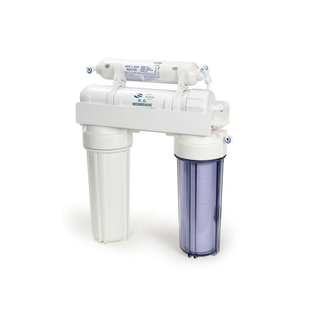
MAW-50 4-Stage (50 GPD)
Pure-75 Twist-Loc (75 GPD)
Most Popular
Pentair FreshPoint GRO-475B (75 GPD)
PFAS RO, Pentair GRO-575B (5-stage)
ROmate-40 Storage Tank (16" x 33")
Tank size
Under-sink module + 3.2 gal NSF-approved steel tank
14.57"W x 5.46"D x 12.54"H module + 4.4 gal steel tank
17.82"W x 5.46"D x 12.54"H module + 4.4 gal steel tank
16" diameter x 33" tall, pairs with any system here
Membrane GPD ratings (50 or 75 gallons per day) assume ideal pressure and temperature. The NSF-tested real-world production of the FreshPoint GRO-475B is 21.08 gallons per day, which is still 5 to 10 times what a family drinks and cooks with. The pressurized storage tank is what makes the faucet feel instant: the system refills it slowly in the background, you draw from it on demand.
Recovery rate and waste water
Every RO system rinses rejected contaminants to the drain. A conventional system sends 3 to 4 gallons to drain per gallon made. The Pentair FreshPoint Green membranes run 41 to 51% recovery (roughly 1 to 1.4 gallons to drain per gallon made), which is why we lead with them. Either way, the drain water only flows while the tank refills, so a typical kitchen sends a few gallons a day to the drain, not hundreds.
What 4-stage vs 5-stage actually means
Stage count is about protection and polish, not marketing. Stage 1 is sediment plus carbon pre-filtration that protects the membrane from grit and strips the chlorine that would destroy it. Stage 2 is the membrane itself, approximately 0.0001 micron, doing 95%+ of the work. The remaining stages are carbon contact after the membrane: a final taste polish on a 4-stage, and on the 5-stage GRO-575B the extra carbon block contact is part of its certified 99.7% PFAS and 98.8% VOC reduction.
MAW-50 4-Stage (50 GPD)
$275
Household
1-4 people
Bathrooms
Kitchen tap
Capacity
PFAS, lead, arsenic, nitrate, TDS at the tap
Tank size
Under-sink module + 3.2 gal NSF-approved steel tank
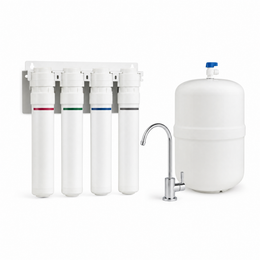
Reverse osmosis pushes water through a semi-permeable membrane with pores of approximately 0.0001 micron, small enough that dissolved solids like lead, arsenic, nitrate, sodium, and PFAS cannot follow the water through. What the membrane rejects rinses to the drain instead of accumulating in a filter. Before the membrane, sediment and carbon pre-filtration protect it from grit and chlorine; after it, a storage tank holds the finished water under pressure and a final carbon stage polishes taste at the faucet. No electricity, no moving parts: line pressure does all the work.
01
Pre-filtration protects the membrane
Water first passes through sediment and carbon pre-filters. The sediment stage stops grit that would scar the membrane; the carbon stage strips chlorine, which chemically destroys thin-film composite membranes (the feed limit is under 2 ppm). On the FreshPoint, stage 1 is a Diamond Flow cartridge that does both jobs in one housing, replaced yearly.
02
The membrane rejects dissolved solids to drain
Line pressure forces water through a spiral-wound membrane with pores of approximately 0.0001 micron. Water molecules pass; dissolved solids like lead, arsenic, nitrate, sodium, and PFAS cannot, and rinse to the drain instead of loading up a filter. The certified FreshPoint figure is 96.3% TDS rejection, with Green membranes recovering 41 to 51% of feed water.
03
Storage tank + carbon polish at the faucet
Finished water fills a pressurized storage tank (3.2 to 4.4 gallons) so your glass fills instantly even though the membrane works slowly. On the way to the dedicated lead-free faucet, a final carbon stage polishes taste. No electricity anywhere in the chain: the system runs entirely on your home's 40 to 100 psi water pressure.
Installation
An afternoon under one sink.
Under-sink RO is the most DIY-friendly system we sell: no drain pit, no electrical, no floor space. Handy homeowners do it in an afternoon with the included fittings; any plumber does it in an hour or two. Every FreshPoint has integrated check valves, so future filter changes don't even require shutting off the water. Aidan is a phone call away if anything looks unusual.
1-2 hrs
Typical install time for a handy homeowner or any plumber. It all happens under one sink: cold line tap, faucet, drain saddle, tank.
0 watts
No electricity needed. Every system here runs on your home's water pressure (40 to 100 psi). No outlet under the sink, nothing to plug in.
100%
Phone support included. Aidan walks you or your plumber through anything unusual about your sink, drain, or fridge line.
What to have ready
Cold water connection under the sinkThe included angle stop adapter valve taps the cold supply line. FreshPoint systems use 3/8" quick-connect fittings; the MAW-50 and Pure-75 use push-connect fittings and included tubing.
A hole for the dedicated faucetEvery system ships with its own lead-free drinking water faucet. An existing sprayer or soap dispenser hole works; otherwise your installer drills one in the sink deck or counter.
Drain connectionThe membrane rinses rejected contaminants to the drain through a saddle fitting on the sink tailpiece. FreshPoint systems use an air-gap faucet, so the faucet body carries the drain line per plumbing code.
Cabinet space for module + tankPlan on roughly half the under-sink cabinet: the FreshPoint module is 14.57"W x 5.46"D x 12.54"H plus a 4.4 gallon storage tank; the MAW-50 and Pure-75 modules pair with a 3.2 gallon tank.
Feed water within membrane limitsRO membranes want pre-treated water: hardness under 10 grains, iron, manganese, and sulfide each under 0.1 ppm, chlorine under 2 ppm, pressure 40 to 100 psi. On most city water you are fine as-is; raw well water usually needs upstream treatment first.
What the install looks like
Shut off the cold water supply under the sink and install the angle stop adapter valve on the cold line.
Mount the dedicated faucet in the sink deck hole and connect its tubing.
Install the drain saddle on the sink tailpiece, above the trap, and connect the drain line (the flow restrictor end goes toward the system, not the drain).
Hang the filter module on the cabinet wall with cartridges hanging down, leaving clearance to eject them straight out for changes.
Connect the color-coded tubing runs: feed to the module, module to the tank, tank to the faucet, and the drain line.
Set the storage tank in place and open its ball valve. Check the tank's air precharge is 5 to 7 psi if it has been in storage.
Open the feed valve slowly and listen. A soft hiss at the drain line is normal while the tank fills. Spraying or dripping means a fitting needs to be reseated: push-connect tubing must bottom out fully in the fitting.
Let the tank fill (2 to 4 hours), then open the RO faucet and drain the first full tank. Repeat per the manual; the first tankfuls flush carbon fines and membrane preservative.
Check every fitting for drips at 24 hours. A dry paper towel under the module makes slow leaks obvious.
Want a second set of eyes before you order? Text Aidan a photo of the space under your sink and your water test. He'll confirm the fit and flag anything your install needs.
Four systems, one decision: how much certification and convenience do you want over the same core technology? All four use sediment and carbon pre-filtration ahead of a thin-film composite membrane of approximately 0.0001 micron, store finished water in a pressurized tank, and include a dedicated lead-free faucet. None needs electricity.
The differences that matter are in the columns: stage count, certified claims, how filter changes work, and the yearly cost of cartridges. Where a spec is not verified by a manufacturer document we say so instead of guessing.
Spec
MAW-50
Pure-75 Twist-Loc
Pentair FreshPoint GRO-475B
PFAS RO (Pentair GRO-575B)
Price
$275
$595
$795
$895
Stages
4
4
4
5
Membrane
50 GPD TFC
75 GPD Twist-Loc
75 GPD GRO75-RC Green
Certifications
None (NSF-approved storage tank)
NSF-approved storage tank; system standard not verified
NSF/ANSI 42, 53, 58 + CSA B483.1
NSF/ANSI 42, 53, 58 + CSA B483.1 + 99.7% Total PFAS (IAPMO R&T vs NSF/ANSI 53)
Certified TDS rejection
Not certified
Not certified
96.3%
95.5%
PFAS claim
RO mechanism only (EPA: 94-99%+), not certified
RO mechanism only, not certified
Not certified for PFAS
99.7% Total PFAS, to under 20 ppt, certified
Filter changes
Standard housings, wrench included, every 6-12 months
Quarter-turn Twist-Loc, no water shut-off, every 6 months
Click-in cartridges, integrated check valves (no shut-off), yearly
Every review is independently collected and verified by Stamped.io, a third-party review platform. We cannot edit or remove reviews.
★★★★★
Drinking water is perfect
The neutralizer is excellent quality, the control valve works flawlessly. I installed it about 2 years ago and it is keeping (along with a whole house filter) the water clear and removing the iron I had. I also put a small reverse osmosis under the sink just to make sure that the drinking water is perfect.
SS
Stuart S., United States
Verified Buyer
Fleck 2510SXT Acid Neutralizer + Softener (added under-sink RO for drinking water) · March 2020
★★★★★
Great pricing, fast shipping, awesome communication
Mid Atlantic Water was great to deal with. I called before ordering and Aidan answered all my questions, confirmed my research and choices were good and that the equipment would handle and correct the condition of my water. My next purchase will be UV light disinfection and reverse osmosis for the drinking and cooking water for peace of mind because I'm on well water. My family couldn't be happier with the results.
JP
Joseph P., United States
Verified Buyer
Well-X-Trol 205 Well Tank (planning RO for drinking water) · May 2020
★★★★★
Better than bottled water
After reading the article '63 million Americans exposed to unsafe drinking water' from USA Today, we decided to test our water. And sure enough, we had lead in our water. So we got this system after talking to the people at Mid Atlantic Water about it. This cleared out the lead, and our water tastes better than Fiji bottled water.
SG
Scott G., United States
Verified Buyer
The Water Sanitizer (tested first, then treated lead) · April 2020
FAQ
Frequently asked questions
Yes. RO is one of the few residential technologies proven against PFAS. The EPA puts reverse osmosis at 94 to 99%+ PFAS removal. Our PFAS Reverse Osmosis System (Pentair GRO-575B, $895) goes further: it is certified by IAPMO R&T against NSF/ANSI 53 to reduce Total PFAS by 99.7%, to under 20 ppt, on a test mix including PFOA, PFOS, PFHxS, PFNA, PFHpA, PFBS, and PFDA. If PFAS is on your lab report, that is the system to start with.
Less than the reputation, and the number is on the spec sheet. A conventional RO sends 3 to 4 gallons to drain per gallon made. The Pentair FreshPoint Green membranes we lead with recover 41 to 51% of feed water, roughly 1 to 1.4 gallons to drain per gallon made. The drain only runs while the tank refills, so a typical kitchen sends a few gallons a day to the drain, about one toilet flush.
Yes, and it is what most bottled water actually is. RO removes lead, arsenic, nitrates, PFAS, and 95%+ of dissolved solids. It also removes calcium and magnesium, which is the common concern; most people get those minerals from food, not water. If you want them back for taste, an optional remineralization cartridge is available for the Pure-75 by phone.
Pre and post filters every 6 to 12 months; membranes every 18 months to 3 years. Exact schedules: MAW-50 filter pack ($49) every 6 to 12 months with a $135 membrane every 2 to 3 years; Pure-75 quarter-turn cartridges every 6 months with the membrane every 24 months ($195 kit); FreshPoint cartridges yearly with the membrane every 18 months. FreshPoint systems have integrated check valves, so you change cartridges without shutting off the water.
Yes, the membrane cannot tell good dissolved solids from bad ones. Calcium and magnesium come out along with the lead and PFAS. The honest context: water is a minor mineral source; a glass of milk has more calcium than gallons of tap water. If you prefer mineralized taste, add the remineralization cartridge (Pure-75, phone order) and it dissolves calcium and magnesium back in after the membrane.
Match the technology to the contaminant. Carbon filters excel at chlorine, taste, and odor, and they are cheaper: if bad taste from city chlorine is your only complaint, a carbon system is the honest answer and we will tell you so. But carbon cannot touch dissolved solids: sodium, nitrate, arsenic, fluoride, and TDS pass straight through it.
Reverse osmosis handles both lists: the membrane rejects 95%+ of dissolved solids and its built-in carbon stages cover taste and chlorine at the same tap. If your lab report shows PFAS, lead, arsenic, or nitrates, or you want bottled-water quality at the sink, RO is the right tool.
Yes, and on wells it is often the most important tap in the house, but the membrane needs protection. The manufacturer feed limits are hardness under 10 grains per gallon, iron, manganese, and sulfide each under 0.1 ppm, pH 3 to 11, and microbiologically safe water. Raw well water that violates those numbers fouls a membrane in months instead of years.
The correct order on a well: sediment filtration, then iron or pH treatment if needed, then the softener, then the under-sink RO at the kitchen tap, with UV if bacteria ever shows up. Send us your well test and we will spec the order for free, including telling you if your well water is already membrane-safe as-is.
Tankless wins on space, flow, and waste ratio (typically 2:1 or better), and loses on price (often $850+), proprietary filters, and the fact that every tankless system needs an electrical outlet under the sink for its booster pump. Tank systems like ours run on water pressure alone: nothing to plug in, nothing to fail in a power outage, standard cartridge economics.
Our honest take: for drinking and cooking water, a tank system's 50 to 75 GPD membrane plus a 3.2 to 4.4 gallon pressurized tank serves a family fine, at $275 to $895 instead of $850 to $1,000. If you draw very heavily from one tap (coffee bar, ice machine), add the ROmate-40 storage tank rather than paying the tankless premium.
For most households, either works, because the storage tank does the serving while the membrane refills it in the background. A family drinks and cooks with 2 to 4 gallons a day; even the NSF-tested real-world output of a 75 GPD FreshPoint (21.08 gallons per day) is 5 to 10 times that.
Choose 75 GPD (Pure-75, FreshPoint, or the PFAS RO) if you are 4+ people, run a fridge and ice maker line off the system, cook heavily, or have low water pressure (production drops as pressure drops). Choose the 50 GPD MAW-50 if you want the proven basics at $275.
The certified numbers from the NSF-tested FreshPoint systems: 96.3% of total dissolved solids, 98.6% lead, 88% pentavalent arsenic (at up to 50 ppb), 93.6% fluoride, 96.4% hexavalent chromium, 98.5% copper, 99.1% cadmium, 97.9% selenium, 96.3% barium, 80% radium 226/228, over 99.1% turbidity, and over 99.99% of cysts like Giardia and Cryptosporidium. The 5-stage GRO-575B adds certified 99.7% Total PFAS and 98.8% VOC reduction.
What RO does not handle: dissolved gases like radon and hydrogen sulfide (aeration or carbon treats those), and bacteria on an unsafe well (that is UV's job, upstream or downstream). RO also removes calcium and magnesium; see the minerals question above for the honest trade-off.
RO water gets its own dedicated lead-free faucet because the system makes finished water slowly and stores a few gallons at a time: it is drinking and cooking water, not dishwater. FreshPoint systems use an air-gap faucet, which carries the drain line through the faucet body per plumbing code; a clogged drain shows up as drips at the air gap, by design, instead of backflow into your clean water.
Yes on the fridge: a 1/4 inch line tees off to a refrigerator ice maker or water dispenser. The MAW-50 includes the quick-connect fittings and tubing for it. Clear ice cubes are one of the first things RO owners notice.
Paste your water test below. Aidan replies with the right system (MAW-50, Pure-75, FreshPoint, or the PFAS-certified GRO-575B), whether your well needs pre-treatment before the membrane, and install notes for your sink. Same-day during business hours, next morning otherwise.
✓
Your message is queued for Aidan
Your email client just opened with the message ready to send. Hit send and Aidan will reply same day during business hours.
Aidan
Co-owner. Real person. Not a bot. 7 Days/Week, 8AM-5PM EST