This page is a complete buying guide for sulfur filters for well water (hydrogen sulfide / rotten egg smell removal). It covers: the hot-vs-cold diagnosis (smell only in hot water means the water heater's magnesium anode rod and needs an anode swap, not a filter; smell in cold water means hydrogen sulfide in the well); single-tank Fleck 2510AIO air-injection filters with Katalox Light catalytic media by Watch Water that remove up to 10 ppm hydrogen sulfide plus up to 30 ppm iron and 15 ppm manganese with no chemicals and no salt, in five sizes (1.0 cu ft $1,895 for 1-2 baths, 1.5 cu ft $2,095, 2.0 cu ft $2,295, 2.5 cu ft $2,495 for 3-5 baths the most popular, 3.5 cu ft $3,295 for 5+ baths); a complete 4-stage system with sediment pre-filter, air-injection stage, Centaur catalytic carbon polish, and Viqua VH410 UV for $4,495; sizing by bathrooms and well pump backwash capability (5 to 12 GPM sustained); a brand comparison against Clean Water Store, US Water Systems, and RKIN; why water softeners and plain carbon filters cannot fix sulfur; sulfur bacteria and shock chlorination; chemical injection guidance above 10 ppm; installation steps; and free expert sizing by phone. All systems ship free to all 50 US states. Mid Atlantic Water has specialized in water treatment since 1997.
By Aidan· 32 Year Water Expert, Mid Atlantic Water ·
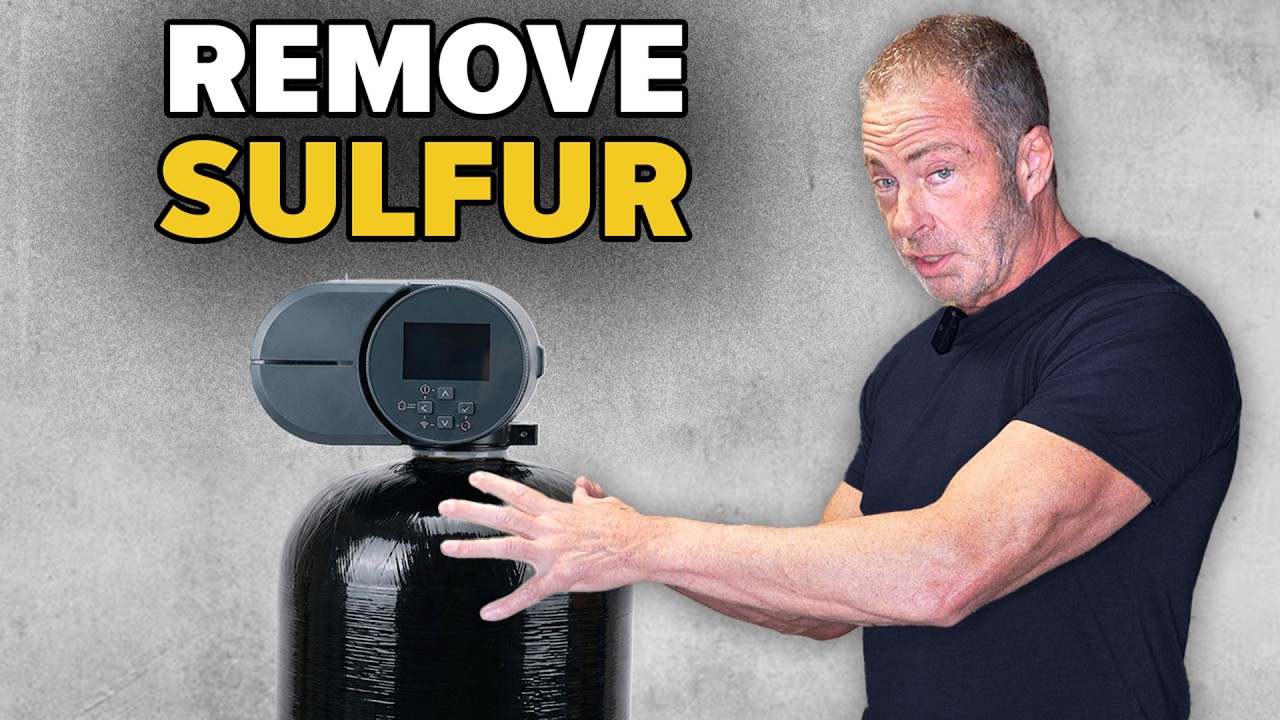
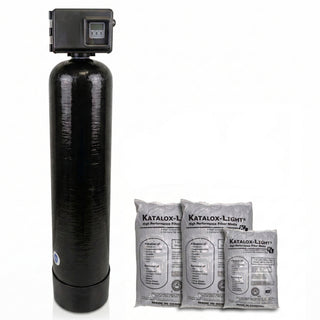
The rotten egg smell in well water is hydrogen sulfide gas, and one air-injection tank removes it at every tap: the Fleck 2510AIO valve holds a compressed air pocket that oxidizes up to 10 ppm of H2S into solid sulfur, and the Katalox Light catalytic bed filters it out, along with up to 30 ppm of iron and 15 ppm of manganese that almost always ride along. No chlorine, no peroxide, no salt, no cartridges.
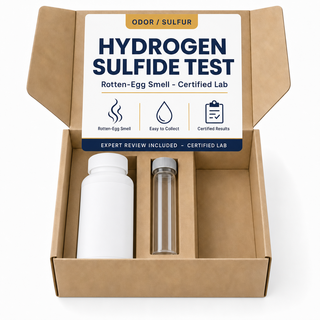
Before you buy anything, run the hot and cold taps separately. If only the hot water smells, your water heater's anode rod is the problem and we will tell you to swap it instead of buying a filter. If the cold water smells, send Aidan your details and he will size the right tank to your bathrooms and well pump in 5 minutes.
Removes up to 10 ppm hydrogen sulfide
No chlorine, no peroxide, no salt
Katalox Light catalytic media
Fleck 2510AIO air-injection valve
Free shipping, all 50 states
30-day return policy
Watch the 9-minute expert answer
After 32 years of expert experience, with over 10,000 customers served since we started Mid Atlantic Water in 1997, the first sulfur question we ask is never about filters: does the cold water smell, or only the hot? Hot-only means your water heater's anode rod, and we will tell you to spend $50 on an anode instead of $2,500 on a system. Cold-water smell means hydrogen sulfide in the well, and one air-injection tank removes it, plus the iron and manganese that almost always ride along, with no chemicals and no salt.
0 products match your filters.
No products match those filters. Try adjusting your water conditions or .
Single-Tank Air Injection Sulfur Filters
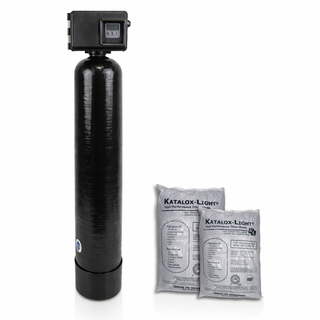
One tank that removes the rotten egg smell at every tap. Each unit pairs the Fleck 2510AIO air-injection valve with Katalox Light catalytic media (Watch Water GmbH, Germany): hydrogen sulfide up to 10 ppm, plus iron to 30 ppm and manganese to 15 ppm in the same pass, with no chemicals and no salt. Sized by bathrooms and your well pump's backwash capability, from the compact 1.0 cu ft to the 20 GPM 3.5 cu ft.
For wells that need more than odor removal: sediment pre-filtration, the 2.5 cu ft air-injection sulfur and iron stage, a Centaur catalytic carbon polish for any residual odor, and Viqua VH410 UV disinfection for bacteria. Four matched stages, one order, 18 GPM continuous.
Photo, PDF, or just type the numbers, whatever’s easiest. Don’t have a test yet? Describe what you’re seeing.
2
Aidan reads it personally
Real co-owner. Not a chatbot, not a script, not a sales rep on quota. He’s sized thousands of systems.
3
Get a direct link to what you need
Aidan texts you the exact product page that fits your water. Buy it, bookmark it, or take the answer elsewhere. No pressure either way.
We never send spam. We never sell your number. Aidan answers personally, 7 days a week, 8a–5p ET.
Sulfur Filter Comparison
Mid Atlantic vs. Clean Water Store, US Water Systems & RKIN
Honest head-to-head: how our air-injection sulfur filters compare to the systems most shoppers also look at. Framing is taken from each company's own published product pages (June 2026); where a spec is not published we say so instead of guessing.
MAW Sulfur Filter
Clean Water Store
US Water Systems
RKIN
Filter media, named
Katalox Light by Watch Water (catalytic MnO2)
Catalytic carbon + KDF
Catalytic carbon
Media not named
Hydrogen sulfide rating
Up to 10 ppm
Up to 10 ppm
Higher with peroxide injection
Not specified
Iron co-removal in the same tank
Up to 30 ppm iron + 15 ppm manganese
Carbon media: odor focus, not high iron
With added iron stage
Iron and manganese, level not specified
Zero chemicals to buy or refill
Yes: air injection only
Yes (optional peroxide rinse)
No: peroxide feed pump + solution tank
Yes
Control valve platform
Fleck 2510AIO by Pentair, 5 yr warranty
7500-REV proprietary valve
Matrixx proprietary valve
Valve platform not named
Media bed sulfur-bacteria risk
Low: MnO2 media is not a carbon food source
Carbon beds can colonize over time
Carbon polish stage, peroxide sanitizes
Not specified
Sized from your water test, free
Yes, phone or email with Aidan
Self-serve size chart
Configurator
Self-serve
Tells you when a filter will NOT fix it
Yes: hot-water-only smell = anode rod, not a filter
Not addressed on product page
Not addressed on product page
Not addressed on product page
Price range
$1,895 - $4,495
From about $1,649
Configurator pricing
Perpetual sale pricing
The architecture difference that matters is the media. Clean Water Store's 7500 AIR uses the same air-pocket oxidation idea with a catalytic carbon bed, which is honest engineering for odor-only wells; carbon simply cannot also hold 30 ppm of iron, and a saturated carbon bed can become a home for sulfur bacteria over time. US Water Systems' peroxide injection is the right tool above 10 ppm, with the tradeoff of a feed pump to maintain and chemicals to buy forever. Budget aeration gadgets and big-box 1 cu ft units are the undersized systems we most often get calls to replace.
We size by your water test and your well pump, not a headline claim. Hydrogen sulfide level, iron riding along, bathrooms, and the pump's sustained GPM set the tank size. Send us your test and we tell you which size fits, including telling you when the smell is your water heater's anode rod and no filter is needed at all.
Step 1: Find Your Problem
What are the signs of Rotten egg smell (hydrogen sulfide) in well water?
The rotten egg smell has three different causes with three different fixes, and the diagnosis takes two minutes at your own taps. Run the cold water and the hot water separately and smell each. Where the odor lives tells you whether you need a filter, an anode rod, or a shock chlorination, before you spend a dollar.
Rotten egg smell in the cold water (or both hot and cold)
Smell it when you fill a glass at the kitchen tap? That is hydrogen sulfide gas in the well itself, and it is exactly what an air-injection sulfur filter treats: the H2S is oxidized in the air pocket and filtered out, up to 10 ppm. The smell is usually strongest first thing in the morning after water sits in the pipes overnight.
→YESSulfur filter fixes this
Smell ONLY in the hot water
If the cold water smells fine and only the hot side stinks, the problem is your water heater, not your well. The magnesium anode rod inside the tank reacts with sulfate in the water and produces the odor. A whole-house filter will not fix this. The fix is swapping the anode for an aluminum-zinc or powered anode rod, a plumber job that costs a fraction of a filter system.
→NOAnode rod swap, not a filter
Smell comes and goes, worst on the first draw
An odor that appears after the water sits, at certain faucets, or only on the first morning draw often points to sulfur bacteria colonizing the well, the plumbing, or an old carbon filter bed. Treatment usually starts with shock chlorinating the well, then an air-injection filter to handle the H2S the bacteria keep producing. Severe bacteria cases pair the filter with UV.
Most sulfur calls we take fit one of these patterns. Find your situation and you'll see exactly which fix to start with, including the one that isn't a filter.
Smell in the cold waterH2S in the wellRotten egg odor at the cold tap means hydrogen sulfide gas in the well itself
+
3-5 bathroom home3-8 peopleThe 2.5 cu ft AIO is the size we recommend most: 17 GPM service flow
Cold-water smell and just want it handled? The 2.5 cu ft 2510AIO at $2,495 is the size we recommend most: 17 GPM for 3 to 5 bathrooms, up to 10 ppm of hydrogen sulfide plus iron and manganese. Smaller home? The 1.5 cu ft is $2,095. Above 10 ppm of H2S, call us about chemical injection instead. Keep scrolling for sizing.
Size by bathrooms and your well pump, not by smell strength. Every size in the family handles up to 10 ppm of hydrogen sulfide (the compact 1.0 caps at 5 ppm); what changes is service flow and the backwash the well pump must sustain for 8 to 10 minutes. A 1 to 2 bath home fits the 1.0 or 1.5 cu ft (5 GPM backwash). Three to five baths is 2.5 cu ft territory (10 GPM backwash), our most-recommended size. Five or more baths needs the 3.5 cu ft and a pump that can sustain 12 GPM. If your pump can't keep up, step down a size, never up.
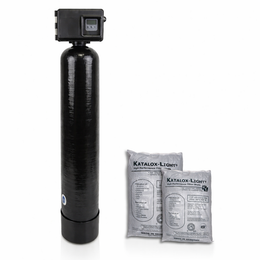
1.0 cu ft AIO (10" x 44")
1.5 cu ft AIO (10" x 54")
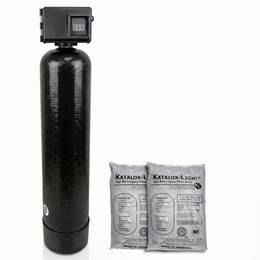
2.0 cu ft AIO (12" x 52")
2.5 cu ft AIO (13" x 54")
Most Popular
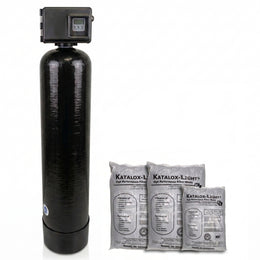
3.5 cu ft AIO (14" x 65")
4-Stage Complete System
Tank size
10" x 44" tank, approx. 52" installed
10" x 54" tank, 62" installed
12" x 52" tank, approx. 60" installed
13" x 54" tank, 62" installed
14" x 65" tank, 73" installed
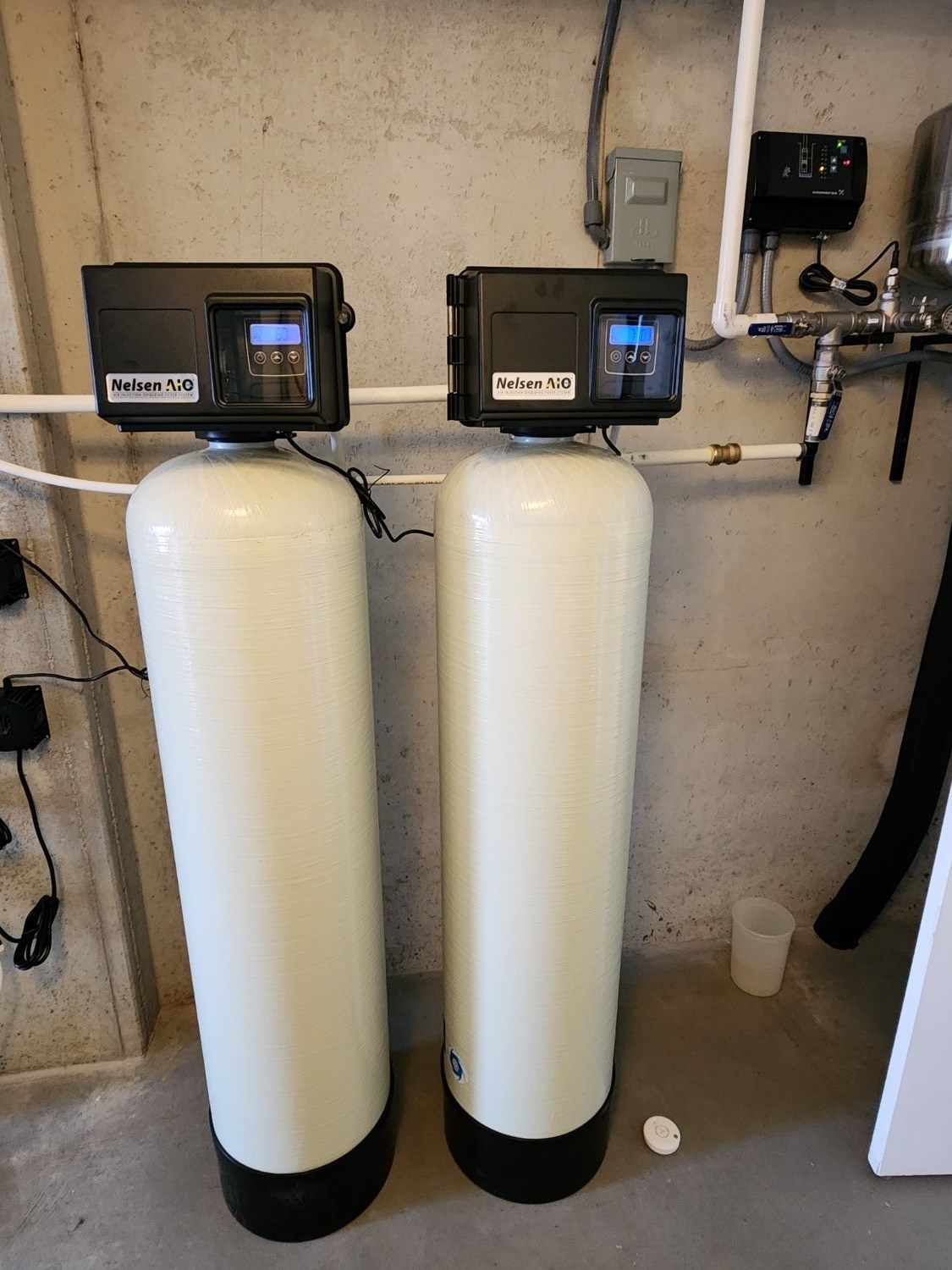
Two 13" x 54" tanks + Big Blue 20" + Viqua VH410 UV
Before sizing anything, run the cold tap and the hot tap separately and smell each. Cold water smells: hydrogen sulfide is in the well, and an air-injection filter treats it. ONLY the hot water smells: the odor is being created inside your water heater by the magnesium anode rod, and the fix is an anode swap (aluminum-zinc or powered anode), not a filter. We turn away those sales every week, because a filter cannot fix a hot-water-only smell.
Backwash GPM: what your well pump must sustain
Each tank cleans itself by backwashing, and your well pump has to sustain that flow for 8 to 10 minutes: 5 GPM for the 1.0 and 1.5 cu ft, 7 to 8 GPM for the 2.0, 10 GPM for the 2.5, and 12 GPM for the 3.5. If your pump cannot sustain the backwash flow, step DOWN a size, never up. An under-backwashed bed fouls and the smell comes back.
ppm of H2S: the 10 ppm line
Katalox Light air injection handles up to 10 ppm of hydrogen sulfide (the compact 1.0 cu ft caps at 5 ppm), while also removing iron to 30 ppm and manganese to 15 ppm in the same tank. Above 10 ppm, the honest answer is chemical injection (chlorine or peroxide feed with a contact tank), which costs more to run but is the right tool for extreme sulfur. Test first; most residential sulfur wells fall well under 10 ppm.
Hydrogen sulfide is a dissolved gas, which is why softeners and cartridge filters can't touch it: there is nothing solid to catch yet. An AIO filter solves that inside one tank. The Fleck 2510AIO valve maintains a compressed pocket of air at the top; incoming well water falls through the pocket and the H2S oxidizes into elemental sulfur, a filterable solid. The Katalox Light bed below (a catalytic manganese dioxide media made by Watch Water in Germany) catches the precipitated sulfur, along with oxidized iron and manganese, then backwashes everything to the drain and draws a fresh air pocket. No chlorine, no peroxide, no salt, no compressor.
01
The valve maintains a compressed air pocket
The Fleck 2510AIO control valve draws and holds a pocket of compressed air in the top of the tank, refreshing it automatically at each backwash. No external compressor, no chemical feed pump. Incoming well water sprays down through that pocket on its way to the media bed.
02
Oxygen turns the H2S gas into a filterable solid
Hydrogen sulfide is a dissolved gas, which is why cartridge filters and softeners cannot catch it. Falling through the oxygen-rich air pocket oxidizes the H2S into elemental sulfur, a solid particle, the same way it converts dissolved iron and manganese into filterable rust and oxide.
03
Katalox Light catches it, then backwashes it to drain
The bed of Katalox Light (a catalytic manganese-dioxide-coated media made by Watch Water in Germany) filters out the precipitated sulfur, iron, and manganese and catalytically speeds the oxidation along. Every 2 to 4 days the valve backwashes the trapped solids to the drain and draws a fresh air pocket. Media life: 8 to 10 years.
Installation
We ship it. Your plumber installs it.
Every utility room is different, so we recommend hiring a licensed plumber. If your plumber has installed a water softener or iron filter, this is the same job minus the brine tank: one tank, inlet, outlet, drain line, and a wall outlet. Aidan is a phone call away if your plumber has questions.
2-4 hrs
Typical install time for a licensed plumber. One tank, four connections: inlet, outlet, drain line, and a standard outlet.
120V
Standard wall outlet. The Fleck 2510AIO valve plugs into a standard 110 to 120 volt grounded outlet and draws the air pocket itself: no compressor, no chemical pumps.
100%
Phone support included. Aidan walks your plumber through anything unusual about your specific setup.
What to have ready
1" plumbing with shut-offsInlet and outlet at the main line after the pressure tank, with valves to isolate the system. A 1 inch stainless bypass valve ships with every unit.
Drain line for backwashThe tank backwashes trapped sulfur and iron to a drain every 2 to 4 days. A floor drain, utility sink, or standpipe within reach of the 1/2 inch drain line works.
Standard 120V outletThe 2510AIO digital valve runs on a standard 110 to 120 volt grounded outlet. No compressor and no chemical feed pump to wire.
Ceiling clearance for your sizeInstalled heights run from about 52 inches (1.0 cu ft) to 73 inches (3.5 cu ft). The 2.0 cu ft at about 60 inches is the go-to under low basement ceilings.
A well pump that can sustain the backwash5 GPM for the 1.0/1.5, 7 to 8 GPM for the 2.0, 10 GPM for the 2.5, 12 GPM for the 3.5, sustained for 8 to 10 minutes. Not sure? Tell us your pump HP and well depth and we will tell you.
What your plumber will do
Position the tank after the pressure tank, and after the acid neutralizer if your pH is below 5.6. The sulfur filter goes BEFORE any water softener or carbon polish.
Level the tank. The media ships separately and loads through the top with the included funnel: gravel underbed first, then the Katalox Light.
Attach the bypass valve to the 2510AIO control head so the system can be isolated without shutting the house down.
Plumb 1" inlet (IN) and outlet (OUT), matching the flow arrows on the valve body. CPVC with solvent cement or PEX with SharkBite fittings both work.
Run the 1/2" drain line to a floor drain, utility sink, or standpipe with an air gap.
Plug the valve into a standard 120V grounded outlet.
Open the water valve slowly, 1/4 turn at a time. Katalox Light is a dense media; a sudden rush can channel the bed before it settles, and channels mean untreated water sneaking past the media.
Set the backwash schedule: every 2 to 4 days depending on your sulfur and iron load. The quick-start card covers it, and Aidan programs it with you by phone if you prefer.
Run a manual backwash cycle, checking for leaks at each cycle position. Expect slightly milky water for the first days: that is harmless air from the freshly drawn air pocket.
Show your plumber exactly what's going in. The system builder generates a plumbing schematic for your specific setup. Send it to your plumber before install day.
Air injection vs carbon vs chemical injection for sulfur
Five technologies get sold for sulfur smell, and they are not interchangeable. Air injection with catalytic media is the zero-chemical workhorse up to 10 ppm. Catalytic carbon alone handles trace odor but caps out fast. Plain activated carbon saturates and can breed sulfur bacteria that make the smell worse. Chemical injection is the honest answer above 10 ppm, at the cost of a feed pump and chemicals forever. Greensand and Birm are the older oxidizing medias that Katalox Light superseded.
The comparison below is by capability, not marketing. If your test says more than 10 ppm, skip the AIO and call us about chemical injection; we would rather route you right than sell you wrong.
Feature
Katalox Light Air Injection (Ours)
Catalytic Carbon + Air
Plain Activated Carbon
Chemical Injection
Greensand / Birm
Hydrogen sulfide capacity
Up to 10 ppm
Up to about 10 ppm, odor focus
Trace only (under about 1 ppm)
Above 10 ppm, the right tool there
Low; Birm handles little H2S
Iron co-removal
Up to 30 ppm in the same tank
Low; carbon is not an iron media
None
Yes, with the chemical dose
Moderate; greensand needs regenerant
Manganese co-removal
Up to 15 ppm
Low
None
Yes
Moderate
Chemicals to buy
None, ever
None (optional peroxide rinse)
None
Chlorine or peroxide forever
Potassium permanganate (greensand)
Sulfur bacteria risk in the bed
Low: MnO2 media is not a food source
Carbon beds can colonize over time
High once saturated
Low: chlorine sanitizes
Low
Ongoing maintenance
Self-backwashing; media 8-10 yrs
Self-backwashing; carbon 3-5 yrs
Cartridges or re-beds, frequent
Feed pump + solution tank upkeep
Regenerant refills + backwash
pH requirement
5.6 to 10.0
Wide
Wide
Wide
Birm needs pH above 6.8
Price
$1,895 - $3,295
From about $1,649
Cheap but the wrong tool
Higher upfront + chemicals forever
Legacy; rarely specified new
Real customers, real wells
What owners say about the 2510AIO systems in this collection
Every review is independently collected and verified by Stamped.io, a third-party review platform. We cannot edit or remove reviews.
★★★★★
Solved my very high iron issues! Great customer service!
I have well water with over 20 ppm ferrous and 7 ppm of ferric iron, along with manganese and some sulfur. I was rejected by local water companies saying they could not help me. I purchased two Fleck 2.5 cu. ft. 2510AIO tanks with Katalox-Light media and air injection. Aiden, the owner, was extremely helpful and responsive to my numerous calls and texts. Wow...and now the tanks reduced the iron to literally zero! Highly recommend Mid-Atlantic, especially if you have significant water quality issues!
AH
Amy H., United States
Verified Buyer
Fleck 2510AIO 2.5 Cubic Foot (Katalox Light) · October 2024
★★★★★
Iron filter
Works very well taking iron and rotten egg smell from the well water. Very satisfied.
JC
James Carver, United States
Verified Buyer
Fleck 2510AIO Air Injection Control Valve · March 2020
★★★★★
Works as advertised
The filter works as advertised - immediately noticed vast improvement of smell/taste of water. No more stains/orange toilet bowls. Milky bubbles after backwash and impacts to pH were as noted.
VB
Verified Buyer, United States
Verified Buyer
Fleck 2510AIO 2.5 Cubic Foot (Katalox Light) · December 2025
FAQ
Frequently asked questions
Yes, and air-injection oxidation is the proven chemical-free way. Hydrogen sulfide is a dissolved gas, so it has to be oxidized into a filterable solid first. An AIO filter maintains a compressed air pocket inside the tank: water falls through it, the H2S oxidizes to elemental sulfur, and the Katalox Light media bed catches it, up to 10 ppm. The same tank also removes iron to 30 ppm and manganese to 15 ppm, which usually ride along on sulfur wells.
First find out where the smell lives. Run the cold tap and hot tap separately. If only the hot water smells, the odor is made inside your water heater by the magnesium anode rod, and the fix is an anode swap, not a filter. If the cold water smells, hydrogen sulfide is in the well: an air-injection sulfur filter removes it at every tap. If the smell comes and goes or lives at one faucet, suspect sulfur bacteria and start with a well shock chlorination.
At typical well levels it is a nuisance, not a poison. Your nose detects hydrogen sulfide far below harmful concentrations, at just a few parts per billion. The real costs are quality of life and plumbing: H2S corrodes copper, silver, and steel, blackens fixtures, and sulfur bacteria can foul pressure tanks and water heaters. The smell also makes the house hard to sell. And because the gas can signal other problems, a water test is the smart first step.
Match the technology to your level. Up to 10 ppm, a single-tank air-injection filter with catalytic media (Katalox Light) is the best combination of effectiveness, zero chemicals, and zero ongoing cost. Below about 1 ppm, catalytic carbon alone can work as a polish. Above 10 ppm, chemical injection (chlorine or peroxide with a contact tank) is the honest answer. Plain carbon cartridges and water softeners are the two most common wrong purchases for sulfur.
Flushing helps for minutes, not days. Hydrogen sulfide is strongest on the first draw after water sits in the pipes overnight, so running a tap clears it briefly, but the gas returns as soon as fresh well water arrives. If a smell disappears permanently after flushing, that points to sulfur bacteria in a fixture or the water heater rather than H2S in the well. Persistent cold-water odor means the well itself, and that is treated with an air-injection filter, not flushing.
Because the smell is being manufactured inside your water heater, not coming from your well. The magnesium anode rod that protects the tank from corrosion reacts with naturally occurring sulfate in the water and generates hydrogen sulfide right there in the tank. The cold lines never see it, which is why the cold tap smells fine.
The fix is a plumber visit, not a filter: replace the magnesium anode with an aluminum-zinc anode or a powered (impressed current) anode, and flush the heater. We tell every hot-only caller the same thing, because a whole-house filter sits upstream of the heater and cannot remove a smell created downstream.
No. Hydrogen sulfide is a dissolved gas, and a softener's cation resin exchanges dissolved metal ions like calcium and magnesium. There is nothing in a softener that captures a gas, so the smell passes straight through, and H2S actually degrades softener resin over time.
The right order on a smelly, hard well is the air-injection sulfur filter first, then the softener. The AIO strips the H2S, iron, and manganese that would otherwise foul the resin, and the softener handles hardness behind it.
Plain activated carbon adsorbs trace odors below roughly 1 ppm, and for a while it works. Then the bed saturates with sulfide, and worse, sulfur bacteria colonize the carbon and start producing H2S inside your own filter. We take calls every month from homeowners whose water smells worse than before the carbon tank went in.
Carbon's honest job in a sulfur train is the polish stage after oxidation, not the primary treatment. If you keep a carbon tank in a sulfur train, re-bed it with Centaur catalytic carbon (made by Calgon Carbon), which is engineered for hydrogen sulfide; that is exactly what stage 3 of our 4-stage system uses.
Sulfur bacteria (and iron bacteria, which usually travel together) live in wells, pressure tanks, and old filter beds, and they produce H2S as they feed. The tell: a smell that comes and goes, lives at certain faucets, or is worst on the first morning draw rather than constant at every cold tap.
Treatment starts with shock chlorinating the well and plumbing to knock the colony down, then an air-injection filter to handle the H2S on an ongoing basis. Severe or recurring cases add UV disinfection after filtration, which is exactly why the 4-stage system ends with a Viqua VH410. A slimy black or rusty coating inside the toilet tank is the classic visual confirmation.
Yes, more than most people expect. Oxidation of hydrogen sulfide works best with the pH around 8, and Katalox Light helps by nudging pH upward slightly during service. The operating range of the system is pH 5.6 to 10.0.
If your well tests below 5.6, an acid neutralizer goes upstream of the sulfur filter; it raises the pH into the effective range and protects your plumbing from the acidic water at the same time. Sulfur wells on the acidic side are common in our region, and the two-tank combination is a setup we spec weekly.
Almost none, which is the point of choosing air injection below 10 ppm. There are no chemicals to refill, no salt, no cartridges, and no compressor. The valve backwashes the bed automatically every 2 to 4 days and redraws its own air pocket each time.
The Katalox Light bed lasts 8 to 10 years before a re-bed, which costs roughly $400 to $600 in media and reuses your tank and valve. Expect slightly milky water for the first days after install; that is harmless excess air and it clears on its own.
Then air injection alone is the wrong tool, and we will tell you that before you buy. Above 10 ppm the proven approach is chemical injection: a chlorine or peroxide feed pump with a contact tank to oxidize the heavy H2S load, usually followed by a catalytic carbon polish.
It costs more to run (chemicals to buy, a feed pump to maintain), which is exactly why we do not push it on the 95% of sulfur wells that test under 10 ppm. Call Aidan at 800-460-5810 with your test result and he will spec the right train honestly.
Tell Aidan what you smell and where. He replies with the right system (which AIO size, the 4-stage train, or an anode rod swap if the smell is only in your hot water), plus install notes for your layout. Same-day during business hours, next morning otherwise.
✓
Your message is queued for Aidan
Your email client just opened with the message ready to send. Hit send and Aidan will reply same day during business hours.
Aidan
Co-owner. Real person. Not a bot. 7 Days/Week, 8AM-5PM EST