


Best Whole House Water Filter for Chlorine (and Chloramine Removal)
City Water Filtration See our complete city water treatment guide.
Best Whole House Water Filter for Chlorine (and Chloramine Removal)
If your city water smells like a pool, leaves a chemical taste, or dries out your skin and hair, a whole house carbon filter solves it at every tap in your home. See our complete whole house water filter guide.
Aidan answers the ten questions city water customers call and ask about high chlorine: which carbon to use, whether it handles chloramine, how to size the tank, what the media costs, and what renters can do instead (2:03).
Want the complete picture on carbon filtration? Start with our Carbon Filters for Water: The Complete Guide, or the broader Complete Guide to Water Filtration Systems.
The Best Whole House Water Filter for Chlorine Removal
Clack 2.5 Cubic Foot Non-Backwashing Whole House Carbon Filter ($1,695)
- Uses Centaur catalytic activated carbon (coconut shell based), which removes both chlorine and chloramine. Standard carbon only removes chlorine.
- No electricity, no drain line needed. Non-backwashing upflow design makes installation simple: just plumb it inline.
- Vortech tank with built-in distributor plate. No gravel underbed.
- Handles up to 17 GPM flow rate, enough for most homes without noticeable pressure drop.
- Media lasts 4 to 5 years before needing a cleanout and replenishment.
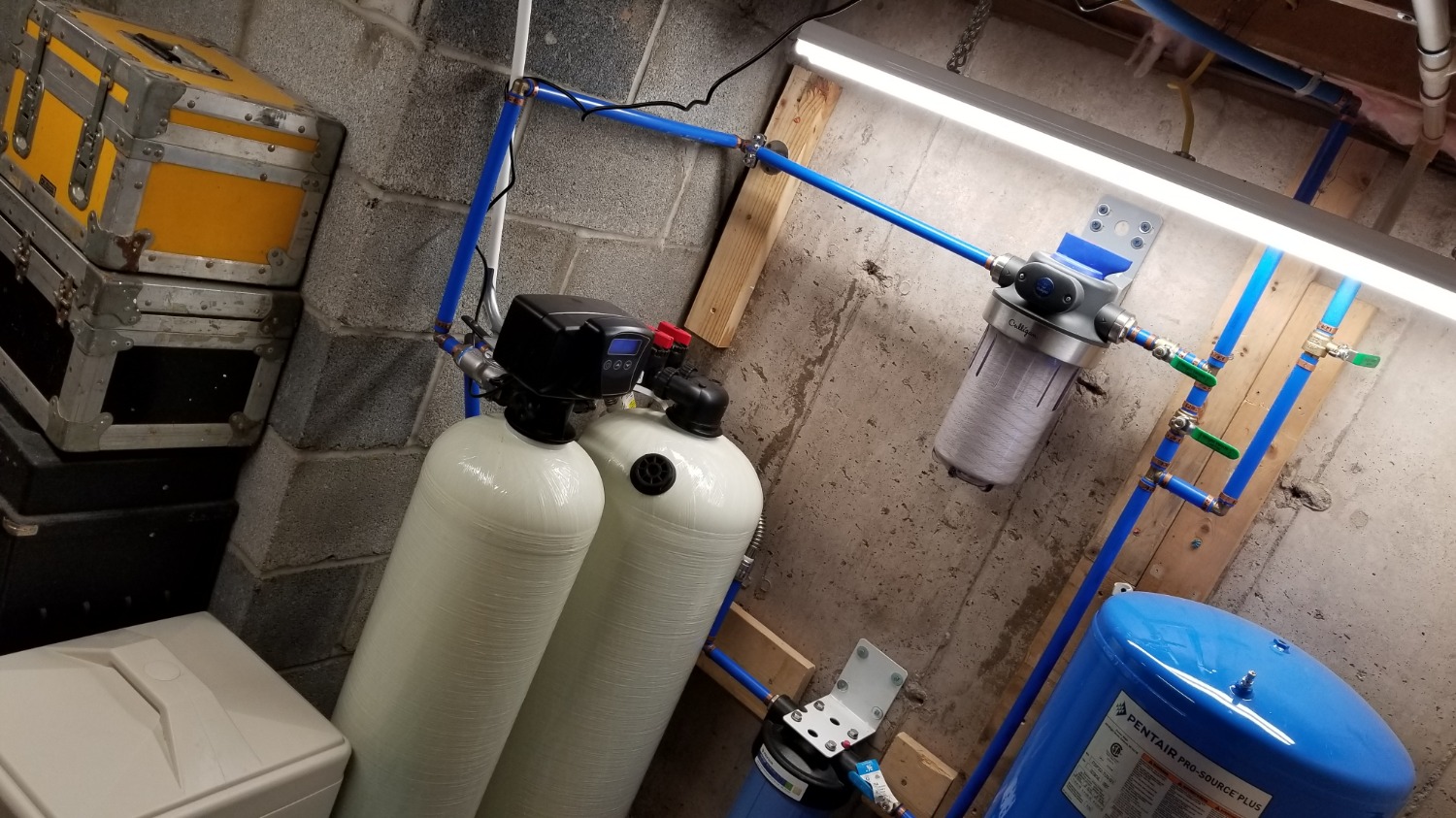
- This is the same setup Aidan uses on his own city water. Non-backwashing carbon filter first, then a water softener. It handles the chlorine, chloramine, taste, odor, and volatile organic compounds (VOCs) before the water reaches the rest of the house.
For smaller homes (1-2 bathrooms): Clack 1.5 Cubic Foot Non-Backwashing Carbon Filter ($1,495)
For homes that also need a water softener: Clack 2.5 Carbon Filter & Fleck 64,000 Grain Water Softener Package ($3,795)
Call Aidan at 800-460-5810 if you want help choosing the right size for your home.
Is a whole house carbon filter right for your water?
Answer 3 quick questions and we'll confirm if this system matches your situation.
What's in this guide:
- Chlorine vs. Chloramine (Why It Matters)
- Comparison: Whole House Carbon vs. RO vs. Pitcher
- Our Recommended Systems and Prices
- The Fluoride Question (Honest Answer)
- Do You Also Need a Water Softener?
- How a Whole House Carbon Filter Works
- Maintenance and Carbon Media Life
- If You Rent and Cannot Install Anything
- Real Customer Experience
- Frequently Asked Questions
Chlorine vs. Chloramine: Why It Matters for Your Filter Choice
This is the single most important thing to understand before buying a whole house water filter for chlorine removal. Your city water uses one of two disinfectants, and they require different filtration approaches.
Chlorine (Cl₂)
- Used by most water utilities
- Strong pool-like smell and taste
- Dissipates relatively quickly
- Removed by standard activated carbon
- Easier to filter out
Chloramine (NH₂Cl)
- Growing in use (chlorine + ammonia)
- Less noticeable smell, still harmful
- Does not dissipate by sitting out
- Requires catalytic carbon to remove
- Harder to filter; standard carbon is inadequate
How to check which disinfectant your city uses: Call your water utility and ask, or look up your annual Consumer Confidence Report (CCR). It's required by the EPA and usually available on your utility's website. If the report lists "chloramine" or "monochloramine" as the disinfectant, you need catalytic carbon.
Whole House Carbon Filter vs. Reverse Osmosis vs. Pitcher Filters
There are three common approaches people consider for removing chlorine from their water. Here is how they compare in terms of what they actually do for you.
| ✅ Whole House Carbon Filter | Reverse Osmosis (RO) | Pitcher / Fridge Filter | |
|---|---|---|---|
| Treats | Every tap in your home | One faucet (usually kitchen sink) | One pitcher at a time |
| Removes chlorine? | Yes | Yes | Partially |
| Removes chloramine? | Yes (with catalytic carbon) | Yes (with carbon pre-filter) | Rarely |
| Removes fluoride? | No | Yes | No (most models) |
| Shower / bath protection? | Yes | No | No |
| Protects appliances? | Yes | No | No |
| Flow rate | Up to 17 GPM | ~0.5 GPM (slow) | Minutes per glass |
| Installation | Plumb on main line (owner-serviceable) | Under-sink connection | None |
| Ongoing cost | Media replenish every 4-5 years | Filter changes every 6-12 months | Filter every 1-2 months (~$8-15 each) |
| Best for | Chlorine/chloramine at every tap | Fluoride + drinking water purity | Renters, temporary fix |
Our Recommended Whole House Carbon Filters (with Current Prices)
These are the systems we sell. All use Centaur catalytic activated carbon in Vortech tanks, so they handle both chlorine and chloramine.
Non-Backwashing Carbon Filters (Simplest Installation)
These are the systems Aidan recommends most for city water. No electricity needed, no drain line, no programming. Just plumb it inline and it works.
| System | Best For | Price | |
|---|---|---|---|
| Clack 1.5 CF Non-Backwashing Carbon Filter | 1-2 bathroom homes | $1,495 | View |
| Clack 2.5 CF Non-Backwashing Carbon Filter | 3+ bathroom homes (Aidan's pick) | $1,695 | View |
Backwashing Carbon Filters (Higher Capacity)
If you have very high water usage or want the system to self-clean the carbon bed automatically, the backwashing models use the Fleck 2510SXT digital valve. These need a power outlet and a drain line for the backwash water.
| System | Best For | Price | |
|---|---|---|---|
| Fleck 2510SXT 1.5 CF Backwashing Carbon Filter | Higher usage, 1-3 bathroom homes | $1,895 | View |
| Fleck 2510SXT 2.5 CF Backwashing Carbon Filter | Higher usage, 3+ bathroom homes | $2,495 | View |
Carbon Filter + Water Softener Packages (City Water Combo)
Most city water has both chlorine/chloramine and hard water. If yours does, you need both a carbon filter and a water softener. The carbon filter goes first (it protects the softener resin from chlorine damage), and the softener goes second.
| Package | Price | |
|---|---|---|
| Clack 2.5 Carbon Filter & Fleck 64,000 Grain Water Softener | $3,795 | View |
| Fleck 2510SXT Carbon Filter & Fleck 2510SXT Deluxe Water Softener | $3,695 | View |
The Fluoride Question (Honest Answer)
A lot of people search for "water filters that remove fluoride and chlorine" expecting one system to do both. Here is the honest truth.
What does remove fluoride? Reverse osmosis (RO). An RO membrane physically removes fluoride along with a wide range of dissolved contaminants. But RO systems work at a single point of use (typically under the kitchen sink), not whole house.
If you want both chlorine removal at every tap AND fluoride removal from your drinking water, the solution is two systems:
- Whole house carbon filter on your main water line (removes chlorine, chloramine, taste, odor, VOCs from every tap)
- Under-sink RO system at your kitchen faucet (removes fluoride, lead, and other dissolved solids from your drinking/cooking water)
| RO System | Price | |
|---|---|---|
| Pure-75 Reverse Osmosis System (75 GPD, premium) | $595 | View |
This two-system approach is what Aidan recommends for homeowners who want the most complete water treatment on city water. For a side-by-side comparison of both technologies, see Carbon Filter vs Reverse Osmosis: Which Do You Actually Need? The carbon filter protects the whole house, and the RO handles the drinking water purity.
Do You Also Need a Water Softener?
If your city water is hard (and most city water is), then yes. Hard water leaves scale buildup on fixtures, shortens appliance life, and makes soap less effective. A carbon filter does not soften water.
The correct installation order for city water:
(chlorine, chloramine, taste, odor)
(hardness, scale prevention)
(fluoride, drinking water, optional)
If you know you need both, the carbon filter and water softener packages are simpler and more cost-effective than buying each system separately. For a detailed guide on pairing these systems, see Carbon Filter and Water Softener: Do You Need Both?
How a Whole House Carbon Filter Actually Works
City water enters the tank and flows through a bed of Centaur catalytic activated carbon made from coconut shells. As the water passes through, the carbon adsorbs (attracts and holds) chlorine, chloramine, volatile organic compounds (VOCs), and taste/odor compounds. Clean, filtered water exits the tank and flows to every faucet, shower, and appliance in your home.
Backwashing vs. Non-Backwashing
There are two designs, and the choice depends on your situation:
Non-Backwashing (Aidan's Recommendation for City Water)
- Water flows up through the carbon bed (upflow design)
- No electricity required
- No drain line needed
- Simplest installation: just plumb it inline
- Carbon media cleaned out and replenished every 4-5 years
- Lower total cost of ownership
Backwashing (For Higher Water Usage)
- Fleck 2510SXT digital valve automatically backwashes
- Requires a power outlet
- Requires a drain line for backwash water
- Self-cleaning extends carbon life
- Better for homes with very high water usage
- Also available for well water applications
For most city water homes, the non-backwashing design is the better choice. It is simpler, less expensive, and Aidan uses this exact setup on his own city water. The only reason to go with backwashing is if you have unusually high water consumption (large family, irrigation, etc.) or you prefer the system to self-clean.
Maintenance and Carbon Media Life
One of the most common questions we get: "How long does the carbon last, and what does maintenance look like?"
Non-Backwashing Carbon Filter
- Media life: 4 to 5 years of typical household use
- Maintenance: Every 4-5 years, the carbon media gets dumped out, the tank is rinsed, and fresh Centaur catalytic carbon is loaded back in
- How to do it: Disconnect the tank, lay it on its side, use a wet/dry vacuum to pull out the old carbon, then pour in fresh media. Takes about an hour. Aidan's team can walk you through it by phone.
- Replacement media cost: Centaur catalytic carbon is sold by the cubic foot at $295 per cubic foot (1 CF Centaur Activated Carbon, Centaur Carbon 1 CF). You buy as many cubic feet as your tank holds, so a 1.5 CF tank takes about $445 of media and a 2.5 CF tank takes about $740.
Backwashing Carbon Filter
- Media life: Can extend to 5+ years because the automatic backwash cycle keeps the carbon bed clean
- Maintenance: The system handles its own cleaning. You still eventually replace the carbon, but the interval is longer.
- Backwash uses: Approximately 7-10 gallons per minute for about 14 minutes per cycle (roughly 100-140 gallons per backwash, similar to two loads of laundry)
If You Rent and Cannot Install Anything
A whole house carbon filter has to be plumbed into the main line, which most renters cannot do. We get this call often enough that it is worth an honest answer: you cannot get whole-house results without a whole-house system, but you can cover the two places chlorine bothers people most.
- A shower head filter handles the biggest complaint. The shower is where chlorine exposure is worst, because hot water releases it as a vapor you breathe in a small enclosed room. This is the single highest-value fix for a renter.
- A single faucet filter or a pitcher filter handles drinking and cooking water taste.
Be realistic about the trade-offs. These are small carbon cartridges, so they hold very little media and need replacing every one to three months, they do not protect your laundry, dishwasher, or any other tap, and most of them are standard carbon rather than catalytic carbon, which means they do a poor job on chloramine. They are a comfort improvement, not water treatment. If you want to know what you are actually dealing with before spending anything, start with how to test for chlorine in tap water.
We do not sell shower head or pitcher filters, so there is nothing for us to push here. If you are renting, buy the cheap shower filter locally and save the whole house system for when you own the plumbing.
Real Customer Experience
"The Fleck 5600SXT 48,000 Grain Water Softener and neutralizer combo I purchased from Mid-Atlantic was a complete kit that I self installed and am very happy with the unit. The product support was great and the price was great as well. It's worth it to buy from a company you can rely on."
Frequently Asked Questions
What is the best whole house water filter for chlorine removal?
A whole house carbon filter using catalytic activated carbon is the most effective and practical solution. It treats every tap in your home, removes both chlorine and chloramine, and eliminates the chemical taste and odor. For most homes, the Clack 2.5 CF non-backwashing carbon filter ($1,695) is the best balance of performance, simplicity, and value.
Do carbon filters remove chloramine?
Standard activated carbon (GAC) does a poor job with chloramine. You need catalytic carbon, which is specifically designed to break the chloramine molecule apart. All of our whole house carbon filters use Centaur, a catalytic activated carbon Calgon Carbon makes from bituminous coal, which handles both chlorine and chloramine.
Will a whole house carbon filter remove fluoride?
No. Carbon filters do not remove fluoride from water. This is a common misconception. If fluoride removal is important to you, you need a reverse osmosis (RO) system installed at the point of use (typically under the kitchen sink). Many homeowners pair a whole house carbon filter with an under-sink RO: the carbon filter handles chlorine at every tap, and the RO handles fluoride and other dissolved contaminants in the drinking water. For more detail, see Fluoride in Drinking Water: What You Should Know.
How much does a whole house water filter for chlorine cost?
Our non-backwashing carbon filters range from $1,495 to $1,695 depending on size. Backwashing models with the Fleck 2510SXT valve range from $1,895 to $2,495. If you also need a water softener, our carbon + softener combo packages start at $3,695. Budget roughly $800 for a carbon media change every four to five years. All systems include free shipping and free phone support from Aidan.
Will a carbon filter get rid of the chlorine smell and taste in my shower?
Yes. Because a whole house carbon filter sits on the main line ahead of everything else, every shower, tub, and faucet in the house gets filtered water. The pool smell in the bathroom and the chemical taste at the kitchen tap both go away. This is the main reason a whole house tank beats a pitcher or fridge filter: chlorine in a hot shower becomes a vapor you breathe, and no point-of-use drinking water filter does anything about that.
What size carbon filter do I need for my house?
Size it by the number of people in the house, because people are what consume the carbon's capacity. For two to four people, the 1.5 cubic foot tank ($1,495) is enough. For four people or more, go with the 2.5 cubic foot tank ($1,695). If you fall right between the two, take the larger one: the extra carbon buys a longer media interval and more headroom on flow rate for a couple hundred dollars more.
What can I do about chlorine if I rent and cannot install a whole house filter?
Get a shower head filter first. The shower is where chlorine exposure is worst, because hot water releases it as a vapor in a small enclosed room. Add a single faucet filter or a pitcher filter for drinking and cooking water. Be aware of the limits: these cartridges hold very little carbon so they need replacing every one to three months, they do nothing for your laundry or dishwasher, and most use standard carbon rather than catalytic carbon, so they handle chloramine poorly. They are a comfort improvement rather than real water treatment. We do not sell them, so buy locally and save the whole house system for when you own the plumbing.
Do I need a plumber to install a whole house carbon filter?
We recommend installation by a licensed plumber. The non-backwashing models are especially straightforward because they only require a plumbing connection on your main water line: no electrical outlet, no drain line. A licensed plumber typically installs one in a couple of hours, and Aidan supports your plumber by phone at 800-460-5810.
What is the difference between backwashing and non-backwashing carbon filters?
A non-backwashing carbon filter is a flow-through design with no moving parts, no electricity, and no drain line. The carbon media is manually cleaned and replenished every 4-5 years. A backwashing carbon filter has a digital valve (Fleck 2510SXT) that automatically reverses water flow periodically to clean the carbon bed. It needs a power outlet and a drain line, but extends carbon life. For most city water homes, Aidan recommends the non-backwashing design for its simplicity.
How often do you replace the carbon in a whole house filter?
For non-backwashing systems, the Centaur catalytic carbon media typically lasts 4 to 5 years before it needs to be dumped and replaced. For backwashing systems, the media can last 5+ years because the backwash cycle keeps it clean. Replacement Centaur catalytic carbon is available directly from us at $295 per cubic foot, so a full refill of a 2.5 cubic foot tank runs about $800.
Does a whole house carbon filter reduce water pressure?
Very little. Our systems handle up to 17 GPM flow rate, which is more than enough for most homes. Customers consistently report no noticeable pressure drop after installation. The Vortech tank design with its built-in distributor plate helps maintain even flow distribution through the carbon bed.
Should I put the carbon filter before or after the water softener?
Always before. The carbon filter removes chlorine and chloramine before the water reaches the softener resin. Chlorine degrades softener resin over time, so the carbon filter acts as protection for the softener. The correct order is: main water line → carbon filter → water softener → home.
Is a whole house water filter worth it for city water?
If you notice chlorine taste, dry skin from showers, or you simply want cleaner water at every tap, yes. A whole house carbon filter treats all the water entering your home, which means your showers, laundry, dishwasher, and drinking water all benefit. Pitcher filters and fridge filters only treat a fraction of the water you use. At $1,495-$1,695 for a system that lasts years with minimal maintenance, it is one of the most cost-effective water quality improvements you can make.
About the Expert: Aidan Walsh
With over 30 years of hands-on experience in water treatment, Aidan serves as the lead technical expert at Mid Atlantic Water. He uses a non-backwashing carbon filter and Fleck water softener on his own city water at home. He specializes in diagnosing and designing whole-home water treatment solutions for both city and well water, with deep expertise across chlorine, chloramine, hardness, iron, sulfur, acidity, and overall water quality. Call Aidan directly at 800-460-5810 with your water questions.