

How To Fix Acidic Well Water?
Acid Neutralizer Guides
How to Fix Acidic Well Water (Low pH): Step-by-Step Treatment Options
A practical guide to testing, choosing, and installing the right system to raise your well water pH and stop corrosion damage. See our well water problems guide for the bigger picture.
By Aidan Walsh, Water Treatment Specialist • 30+ years of field experience • Updated May 2026
Want the full picture? Start with our Complete Acid Neutralizer Guide.
Watch: How to Fix Acidic Well Water in Under 2 Minutes
Aidan walks through the full fix: how to size the system from your pH and household, why we skip chemical feed systems in most homes, where to install the acid neutralizer, what changes the first week, and the only ongoing maintenance you'll deal with.
TL;DR: How to Fix Acidic Well Water
- The fix: Install a whole-home acid neutralizer where water enters your house. The system uses natural calcite (limestone) to raise pH to a safe range. No chemicals, no electricity in most systems, minimal maintenance.
- pH 6.0 to 6.9: Use a calcite neutralizer. Simple, reliable, handles mild to moderate acidity.
- pH below 6.0: Use a calcite + Corosex (FloMag) blend. Magnesium oxide is more reactive and corrects stronger acidity.
- pH below ~5.3: A calcite + Corosex blend can still work, but extreme acidity needs expert guidance. Call Aidan at 800-460-5810 and he'll walk you through the right setup for your specific water chemistry.
- Cost: $1,195 to $1,695 depending on size, plus about $145/year in calcite refills. Compare that to $5,000+ to re-pipe a house or $1,500+ for a corroded water heater.
- First step: Test your water's pH. A home test kit costs $15 to $30 at any hardware store, but a certified lab test also gives you alkalinity (which you need to size the system correctly). If pH is below 6.5, treatment is strongly recommended.
Ready to choose? See our Buyer's Guide for a side-by-side comparison of every system with current pricing.
Quick Check: What Fix Does Your Water Need?
Answer two questions and we'll point you to the right solution.
1. Do you know your water's pH?
Is Your Well Water Acidic?
- pH below 7.0 is acidic. In private wells, below ~6.5 is where corrosion risk becomes a real concern.
- Common signs: metallic taste, blue-green stains on fixtures (dissolved copper), pinhole leaks in copper pipes, shortened water heater life.
Not sure if your water is acidic? See our guide to signs of acidic water to check your symptoms against the most common warning signs.
Important: low pH itself is usually not the direct health problem. The bigger concern is that corrosive water dissolves metals like copper or lead from your plumbing, which then end up in the water you drink.
What Causes Acidic Well Water
Well water becomes acidic for a few reasons, most of them geological:
- Rainwater and snowmelt: Rain is naturally slightly acidic (around pH 5.6) because it absorbs carbon dioxide from the atmosphere, forming carbonic acid. As it soaks through soil into your well, it can stay acidic if the bedrock doesn't neutralize it.
- Bedrock composition: In areas with granite, sandstone, or other non-limestone bedrock, there's nothing underground to buffer the acidity. This is common in the Mid-Atlantic, New England, and parts of the Southeast.
- Decaying organic material: Leaves, roots, and other organic matter in the soil produce acids as they decompose. Shallow wells and wells in forested areas are especially susceptible.
- Acid rain: In some regions, industrial pollution creates genuinely acidic precipitation that enters the groundwater over time.
The result is the same regardless of the cause: water with a pH below 7.0 that attacks metal plumbing from the inside out. The lower the pH, the more aggressive the corrosion.
Why Low pH Matters (Corrosion, Metals, Plumbing Damage)
- Corrosion: Acidic water attacks metal plumbing, fixtures, and appliances. Copper pipes are especially vulnerable.
- Metal leaching: Corrosion increases dissolved copper and lead at the tap. One customer in Virginia had their copper tested at 1.0 ppm (the EPA action level is 1.3 ppm) with a pH of 6.0.
- Cost: Pinhole leaks, premature water heater failure, and repeated plumbing repairs add up fast. We've seen homeowners spend $5,000+ on re-piping that could have been prevented with a $1,200 neutralizer.
The EPA's secondary guidance references a pH range of 6.5 to 8.5 to reduce nuisance issues like corrosion and metallic taste. Private wells aren't regulated the same way as public water systems, which means it's on the homeowner to test and treat.
Step 1: Test the Right Things (Not Just pH)
Minimum tests
- pH (field test or lab). Home test kits from a hardware store cost $15 to $30 and give a ballpark. For precision, send a sample to a certified lab.
- Alkalinity (helps predict how "buffered" your water is and whether a neutralizer will be effective).
- Hardness (neutralizers add minerals, which raises hardness. Know your starting point so you can decide if you'll also need a water softener).
Strongly recommended if pH is low
- Copper and lead at the tap (especially if you see blue-green staining or have older plumbing). This tells you whether corrosion has already caused a health concern.
- Saturation index (often called LSI) if your lab reports it. LSI estimates corrosivity more accurately than pH alone because it factors in temperature, alkalinity, and hardness.
Tip: if your lab provides LSI or a similar stability index, use it. pH is the primary driver, but it doesn't tell the whole story.
For a step-by-step walkthrough of all three testing methods (strips, digital meter, and certified lab), see our guide on how to test your water's pH at home and with a lab test.
Step 2: Choose the Right Fix
| Your pH (rule of thumb) | Best whole-home solution | Why it works | What to watch for |
|---|---|---|---|
| ~6.0 to 6.9 (mild to moderate) | Acid neutralizer with calcite | Calcite dissolves slowly and raises pH while increasing alkalinity. | May increase hardness. Consider a softener if scale becomes an issue. |
| Below ~6.0 (more aggressive acidity) | Acid neutralizer with calcite + Corosex (FloMag) blend (see our Calcite vs Corosex guide) | Magnesium oxide is more reactive for stronger pH correction. | Can overcorrect. Verify pH after install to avoid scale buildup. See our FloMag usage guide. |
| Very low pH (often below ~5.3) | Call Aidan at 800-460-5810 for expert guidance | Extreme acidity needs a custom approach. A Corosex-heavy blend or specialized setup may be required. | Every situation at this pH level is different. Get expert input before buying. |
Option A: Calcite neutralizer (preferred in most homes)
- What it is: A corrosion-resistant tank filled with calcite (crushed limestone), installed where water enters the house. As water flows up through the media bed, calcite dissolves and raises the pH.
- Best for: Most low pH well water scenarios. This is what we install in roughly 80% of acidic water situations.
- Side effect: Neutralizers add calcium and magnesium back into the water, which can increase hardness. If your hardness was already borderline before treatment, you may need a softener paired with the neutralizer.
- Backwashing vs non-backwashing: Non-backwashing neutralizers are simpler (no drain line, no electricity). Backwashing models periodically flush the media bed, which prevents channeling in harder-use situations.
Shop neutralizers: whole-home acid neutralizers. For sizing help, see our Sizing Guide. For a complete breakdown of how these systems work, see How Does an Acid Neutralizer Work? Ready to buy? Our Buyer's Guide compares every system with current pricing.
What about very low pH (below 5.3)?
If your pH is extremely low, a calcite + Corosex blend can often still handle it, but the blend ratio, tank size, and flow rate all matter more at that level. Every situation is a little different. Rather than recommending a specific system without seeing your water test results, we'd rather talk to you directly. Call Aidan at 800-460-5810 and he'll help you design the right setup.
When you should add pre-filters
- Sediment filter: Protects valves and media if you have sand, silt, or turbidity. Shop sediment filters.
- Iron, sulfur, or manganese issues: Treat these with the right filter so your neutralizer performs consistently. Shop iron and sulfur filters.
Step 3: Install Location and Setup
- Install point-of-entry: The neutralizer goes where the well line enters your home, before the pressure tank or any other treatment. This protects all household plumbing and fixtures.
- Confirm flow sizing: The system must handle your peak household demand (showers, laundry, dishwasher running simultaneously). Our sizing guide walks through the calculation.
- Treatment sequence: If you also need a softener or iron filter, the neutralizer typically goes first so downstream equipment isn't exposed to corrosive water.
- Verify after install: Re-test pH at a tap after the system is online. Also re-test copper and lead if they were previously elevated.
For step-by-step installation instructions, see our Installation Guide.
Step 4: Maintenance and Monitoring
Neutralizer tank maintenance
- Replenish media: Add calcite (or calcite + FloMag blend) as it dissolves. Most homes need to refill once or twice a year. For the full process, see our Servicing Guide.
- Backwash (if your system backwashes): Set the backwash cycle to run every 2 to 3 days. This keeps the bed clean and prevents channeling.
- Re-test pH: Check after installation, then periodically (quarterly is plenty for most homes). If pH starts dropping, it's time to add media.
Common Mistakes to Avoid
- Ignoring hardness after installing a neutralizer. Neutralizers add minerals. If your water was already moderately hard, you could end up trading a corrosion problem for a scale problem. Test hardness before and after, and add a water softener if needed.
- Using too much Corosex (FloMag). Corosex reacts fast. If the blend ratio is too aggressive, pH can overcorrect above 8.0 and cause scale throughout the house. Start with the manufacturer's recommended blend and adjust from there.
- Undersizing the system. A neutralizer that's too small for your household flow rate won't have enough contact time to fully raise pH. Use our sizing guide or call us.
- Not testing copper and lead after treatment. Fixing the pH stops new corrosion, but if lead or copper was already elevated, you should confirm levels have dropped to safe ranges.
- Letting the media run too low. When the calcite bed gets below about a third full, water can channel around the remaining media instead of flowing through it. That means some water gets treated and some doesn't.
Real Customer Results
Clack 2.5 Cubic Foot Non-Backwashing Acid Neutralizer
"It just works! Excellent. Had it installed by a plumber. Brought my pH 6 water, which was picking up an unhealthy level of copper, to about 7.4. Had the water retested by a lab and the copper is well below the threshold for concern. And the water tastes great!"
Clack 2.5 Cubic Foot Vortech Non-Backwashing Acid Neutralizer
"Found the install to be very straightforward, easy for any DIYer. Website videos were very helpful and really a must as many install recommendations in the videos were not part of the written instructions."
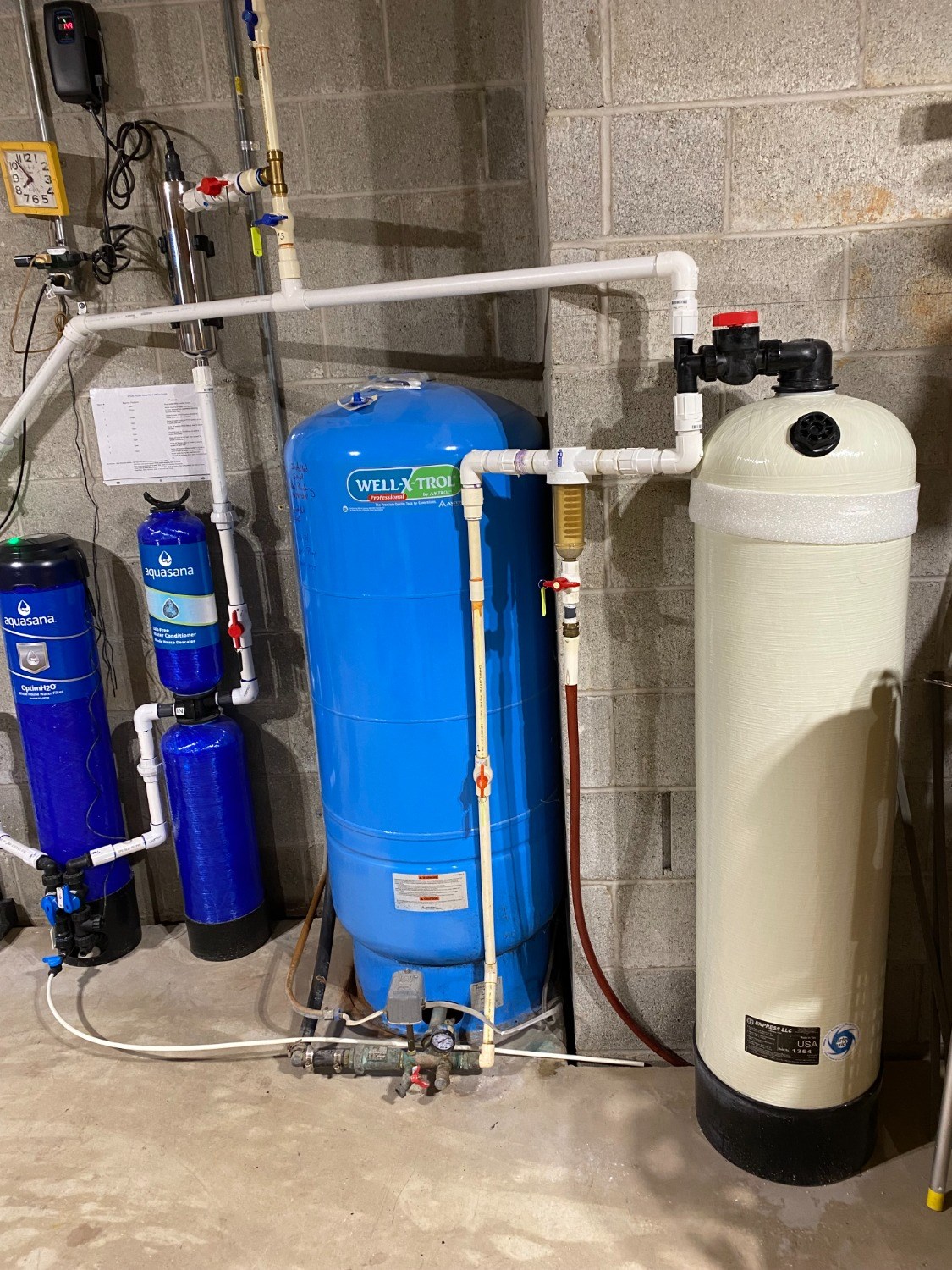
Non-Backwashing Clack 2.0 Cubic Foot Acid Neutralizer
"Fast delivery, easy installation, and Northern Virginia acidic water problem resolved. I recommend watching Mid Atlantic's YouTube video on installing these neutralizers. I used 18 inch flexible SharkBite fittings to connect to the recommended CPVC fittings."
Non-Backwashing Clack 1.5 Cubic Foot Acid Neutralizer
"Shipped fairly quickly and was easy to install. Took my water from a pH of 6 up to just over a pH of 7. Highly recommend if you have acidic water."
Troubleshooting
Blue-green stains on sinks or tubs
This usually means dissolved copper from corroding pipes. Test pH and copper levels. If copper is elevated, an acid neutralizer to raise the pH will stop the corrosion at the source. For removing existing stains, a paste of baking soda and vinegar or a copper-specific cleaner works well.
Metallic taste
Common with low pH and active corrosion. The taste comes from dissolved metals (usually copper or iron). Confirm with a pH test plus metals testing, then treat with a point-of-entry neutralizer.
Pinhole leaks or recurring plumbing failures
A strong sign of corrosive water eating through copper from the inside. Treat the pH first, then assess whether damaged pipe sections need replacing. Once pH is corrected, the corrosion stops and the remaining plumbing should last normally.
pH still low after installing a neutralizer
Check the media level in the tank. If it's low, the water may be channeling around the remaining calcite instead of flowing through it. Refill the media. If the tank is full and pH is still low, you may need to add FloMag (Corosex) to the blend, or the system may be undersized for your flow rate.
Water heater failing prematurely
Acidic water accelerates corrosion inside the water heater tank and eats through the anode rod faster than normal. If your water heater is dying every 3 to 5 years instead of lasting 10+, low pH is a likely culprit. See our full guide: Acidic Water and Your Hot Water Heater.
Frequently Asked Questions
What pH is considered "acidic" for well water?
Any pH below 7.0 is technically acidic. In private well systems, corrosion concerns typically increase below about 6.5, which is the low end of the EPA's recommended range. Below 6.0, treatment is strongly recommended.
Is acidic well water dangerous to drink?
Low pH itself is not the main health risk. The danger is what corrosive water does to your plumbing: it dissolves metals like copper and lead, which then end up in the water you drink. If you have low pH and older plumbing, testing for copper and lead at the tap is important.
How much does it cost to fix acidic well water?
A whole-home acid neutralizer runs $1,195 to $1,695 depending on size, with ongoing calcite refills of about $145 per year. Most homeowners install these themselves. Compare that to the cost of not treating: corroded plumbing, premature appliance failure, and potential re-piping.
Do I need calcite or a calcite + Corosex blend?
Calcite works well for pH 6.0 and above. Below about 6.0, a calcite + Corosex blend provides the extra reactivity needed for stronger correction. Always verify pH after install and adjust if needed.
Will a neutralizer make my water harder?
Often, yes. As calcite dissolves, it adds calcium to the water, which increases hardness. If hardness becomes a problem (scale buildup, soap efficiency), pair the neutralizer with a water softener.
What if my pH is extremely low (below 5.3)?
A calcite + Corosex blend can often still work, but the blend ratio and system sizing become critical at that level. Call Aidan at 800-460-5810 with your water test results and he'll recommend the right approach for your specific situation.
Should I test for lead and copper?
Yes, if pH is low and you see staining or have older plumbing. Fixing the pH stops new corrosion, but you should confirm that metals at the tap have dropped to safe levels after treatment.
How do I raise my well water pH naturally?
A calcite (calcium carbonate) neutralizer is the most common "natural" method. Calcite is crushed limestone, and the process is purely physical and chemical (dissolving minerals, no electricity or chemicals needed). It raises pH while also adding beneficial alkalinity. For the technical details, see How Does an Acid Neutralizer Work?
What causes well water to be acidic?
Most commonly, it's geological. Rain is naturally slightly acidic (pH ~5.6), and when it percolates through soil and rock that lacks limestone or other alkaline minerals, it stays acidic. Decaying organic matter in soil, shallow well depth, and acid rain can also contribute.
Can I fix acidic well water myself (DIY)?
Yes. Most acid neutralizers are designed for DIY installation. You'll need basic plumbing skills (cutting pipe, making connections). Our installation guide walks through every step, and our team is available by phone at 800-460-5810 if you get stuck.